The Battle of Artemisium was a series of naval engagements fought over three days in late summer 480 BCE in the strait between northern Euboea and the mainland of Greece, at the same time as the land battle at Thermopylae. A Greek fleet of about 270 to 330 triremes, most of them Athenian, held off the much larger fleet of Xerxes, which had already been battered by storms. Neither side won outright; when news came that Thermopylae had fallen, the Greeks sailed south to Salamis.
| Date | August or September 480 BCE, on the same days as Thermopylae |
|---|---|
| Place | Off Cape Artemisium, northern Euboea, opposite Aphetae on the Magnesian coast |
| Greek command | Eurybiades of Sparta; Themistocles led the Athenian squadron |
| Greek fleet | 271 triremes, reinforced by 53 more (Herodotus) |
| Persian fleet | Officially 1,207 triremes at the start of the campaign; fewer after storms |
| Persian admirals | Ariabignes, Achaemenes, Prexaspes and Megabazus (Herodotus) |
| Result | Indecisive; Greek withdrawal after Thermopylae |

A plan for land and sea
Xerxes’s army depended on its fleet, which carried supplies and protected the army’s seaward flank as it marched down the coast. The Greek allies saw that if the fleet could be stopped, the army would be in difficulty. They placed their ships at Artemisium, named after a temple of Artemis on the headland, where they could block the channel between Euboea and the mainland and stay in contact with the land force at Thermopylae. If the Persian ships got through the channel, they could land troops behind Leonidas.
The Spartan Eurybiades held overall command because the other allies refused to serve under an Athenian, even though Athens provided more than half the ships. Herodotus says Athens manned 127 ships, with Plataeans helping to row some of them, and lent 20 more to Chalcis.
The fleets
The Persian fleet was not Persian in its crews. Herodotus lists the contingents of the king’s navy: Phoenicians first, with 300 ships, then Egyptians, Cypriots, Cilicians, Ionian and other Asian Greeks, Carians and others. Its admirals were Persians of the highest rank, including Ariabignes and Achaemenes, both sons of Darius. For the navy’s organisation and its Phoenician core, see The Achaemenid Navy.
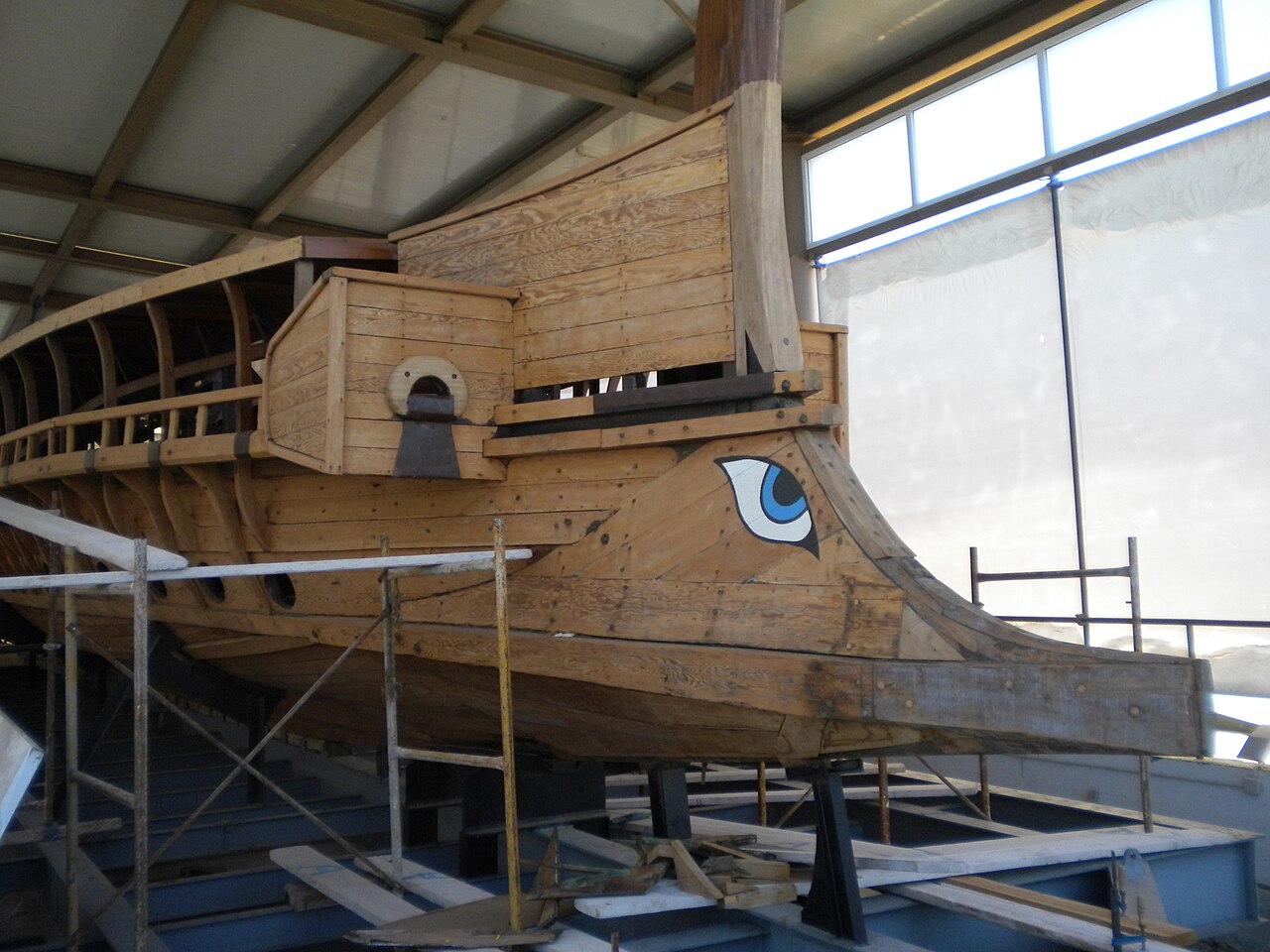
Both sides used the trireme, a fast oared warship about 35 metres long with a bronze ram at the bow, rowed by some 170 men. The Phoenician ships were generally lighter and better handled; the Athenian ships, newly built, were heavier and crewed by less experienced rowers.
Storms before the battle
The weather did more damage than the Greeks. While anchored along the open coast of Magnesia near Cape Sepias, the Persian fleet was caught by a gale that lasted three days. Herodotus says that at least 400 warships were lost, along with countless supply vessels, and that the Athenians had prayed to Boreas, the north wind, for help. The figure is very likely too high, but the storm clearly cost the Persians many ships before any fighting began. The remaining fleet gathered at Aphetae, across the water from the Greeks.
Herodotus also tells a story that shows how Greek tradition later treated Themistocles. When the Greeks thought of retreating, the people of Euboea are said to have paid Themistocles 30 talents to keep the fleet there; he passed small sums to Eurybiades and to the Corinthian commander and kept the rest. True or not, it fits the image of a clever, ambitious man who later ended his life in Persian service.
Three days of fighting
The first day
The Persians sent 200 ships round the outer coast of Euboea to come up behind the Greeks and trap them in the channel. A diver from Scione named Scyllias, who had been serving with the Persians, deserted and warned the Greeks. They attacked the main Persian fleet late in the afternoon, forming a circle with their sterns inward and rams outward, and captured 30 ships before darkness ended the fight.
The second day
That night another storm broke. The 200 ships sent round Euboea were wrecked on the rocky coast that Herodotus calls the Hollows. The same day 53 fresh Athenian ships arrived, and the Greeks attacked and destroyed some Cilician ships.
The third day
On the third day the Persian fleet came out in force. Herodotus describes a hard, even battle with heavy losses on both sides; half the Athenian ships were damaged. On the Persian side, he says, the Egyptians fought best, capturing five Greek ships with their crews. On the same day Leonidas was making his last stand at Thermopylae.
Withdrawal
A messenger brought the news that the pass had fallen. The Greek fleet had no reason to stay and could be trapped, so it withdrew at once, south through the Euripus channel towards Salamis and Athens. Before leaving, Herodotus says, Themistocles had messages cut into rocks near the watering places, calling on the Ionians in the Persian fleet to desert or at least fight badly. The aim was as much to make Xerxes distrust his Ionian ships as to win them over.
Who won
Greek tradition remembered Artemisium as a success that gave the Athenians confidence; the poet Pindar called it the place where the sons of Athens laid the foundation of freedom. In terms of results, the Persian fleet held its position, kept pace with the army and moved south to Phalerum, the harbour of Athens, while the Greek fleet withdrew. Losses on both sides were heavy, but the Persian navy had been worn down more by weather than by battle. Its decisive test came a few weeks later in the narrows of Salamis.
There is no Persian account of Artemisium. As with the other battles of 480 BCE, the only narratives are Greek, and Herodotus, who wrote the fullest one, depended on Athenian informants who had every reason to stress their own part. See the wider campaign in Xerxes’ invasion of Greece.
A famous bronze statue of Zeus or Poseidon, now in the National Archaeological Museum in Athens, was found in a shipwreck off Cape Artemisium in the 1920s. It is often linked with the battle by name, but it was made some decades later and has nothing to do with it.
Persian words from this page
| دماغه | damâgheh | cape, headland |
| کشتی جنگی | kashti-ye jangi | warship |
| فنیقی | Fenighi | Phoenician |
| مصری | mesri | Egyptian |
| باد | bâd | wind |
| دریانورد | daryânavard | sailor |
Sources and further reading
- Herodotus, Histories, Book 7, chapters 89–99 and 175–195; Book 8, chapters 1–23.
- J. F. Lazenby, The Defence of Greece, 490–479 BC (1993).
- J. S. Morrison, J. F. Coates and N. B. Rankov, The Athenian Trireme (2nd ed., 2000).
- Pierre Briant, From Cyrus to Alexander: A History of the Persian Empire (2002).
Want to learn Persian? Get the free Starter Pack
Get the 14-page printable Starter Pack (all 32 letters, a 7-day reading plan, 100 core words and 20 survival phrases) and a short 5-email course. Free.
More in The Achaemenid Empire (550–330 BCE)
- Achaemenes, Teispes and the Early Persian Kings of Anshan
- Cyrus the Great: Birth, Legends and Rise to Power
- Cyrus Conquers Lydia: Croesus and the Battle of Thymbra
- The Persian Conquest of Ionia and Asia Minor
- Cyrus Takes Babylon (539 BCE)
- The Cyrus Cylinder
- Cyrus and the Return of the Jews
- The Death of Cyrus and the Massagetae
- Pasargadae: Cyrus’s Capital and Tomb
- The Tomb of Cyrus through History
- Cambyses II
- Cambyses Conquers Egypt: The Battle of Pelusium
- Bardiya and Gaumata: The Usurper Question
- Darius the Great Takes the Throne
- The Great Revolts of 522–521 BCE
- The Behistun Inscription
- The Persian Conquest of the Indus Valley
- Darius’s Scythian Campaign
- Darius’s Canal from the Nile to the Red Sea
- Darius’s Reforms: Satrapies, Taxes and Law
- The Royal Road and the Persian Postal System
- The Daric: Achaemenid Coinage and Economy
- The Ionian Revolt (499–493 BCE)
- The Greco-Persian Wars: An Overview
- Mardonius and the First Persian Expedition to Greece (492 BCE)
- The Battle of Marathon (490 BCE)
- The Death of Darius I and the Succession of Xerxes
- The Royal Tombs of Naqsh-e Rostam
- Xerxes I: King of Kings (486–465 BCE)
- Xerxes’ Invasion of Greece (480–479 BCE)
- The Battle of Thermopylae (480 BCE)
- The Battle of Artemisium (480 BCE)
- The Persian Capture of Athens (480–479 BCE)
- The Battle of Salamis (480 BCE)
- The Battle of Plataea and the End of the Invasion (479 BCE)
- The Palace of Darius at Susa
- Building Persepolis: How Darius and Xerxes Built Parsa
- The Persepolis Fortification and Treasury Tablets
- Herodotus and the Persians
- The Apadana Reliefs: Nations Bringing Gifts
- The Achaemenid Paradise Gardens
- The Persian Immortals and the Achaemenid Army
- The Achaemenid Navy
- Religion of the Achaemenid Kings
- Women of the Achaemenid Court
- Old Persian Language and Cuneiform
- Egypt under Persian Rule
- Babylon under Persian Rule
- Artaxerxes I
- The Peace of Callias
- Darius II and the Peloponnesian War
- Famous Satraps of the Persian Empire
- Artaxerxes II Mnemon
- Cyrus the Younger and the Battle of Cunaxa
- The King’s Peace (387 BCE)
- The Great Satraps’ Revolt
- Artaxerxes III and the Reconquest of Egypt
- Darius III, the Last Achaemenid King
- The Battle of the Granicus (334 BCE)
- The Battle of Issus (333 BCE)
- Alexander Takes Tyre, Gaza and Egypt (332 BCE)
- The Battle of Gaugamela (331 BCE)
- Ariobarzanes and the Battle of the Persian Gate
- The Burning of Persepolis (330 BCE)
- The Death of Darius III and Bessus
- The Legacy of the Achaemenid Empire