The Battle of Salamis was a naval battle fought in September 480 BCE in the narrow strait between the island of Salamis and the coast of Attica, just after the Persians had taken Athens. The allied Greek fleet, led in practice by the Athenian Themistocles, drew the larger fleet of Xerxes into the narrows and defeated it. The defeat ended Persian hopes of finishing the war in 480 and sent Xerxes back to Asia, although his army stayed in Greece for another year.
| Date | Late September 480 BCE (exact day debated) |
|---|---|
| Place | Strait of Salamis, west of Piraeus |
| Greek command | Eurybiades of Sparta, with Themistocles of Athens |
| Persian command | Xerxes I watching from the shore; admirals including Ariabignes |
| Greek fleet | 310 (Aeschylus) or about 380 (Herodotus) triremes |
| Persian fleet | Unknown at this point; Aeschylus and Herodotus give large figures; modern estimates often 500 to 800 |
| Losses | Diodorus: about 40 Greek and over 200 Persian ships |
| Result | Decisive Greek victory |

Quarrels in the Greek camp
After Artemisium the Greek fleet gathered at Salamis to cover the evacuation of Athens. From the island the crews could see the smoke as the Persians burned the Acropolis. The Peloponnesian commanders wanted to fall back to the Isthmus of Corinth, where their land army was building a wall. Themistocles argued that in the open water off the Isthmus the larger Persian fleet would win, while in the narrows off Salamis numbers would count for little. Herodotus says he finally threatened that the Athenians would take their ships and families and sail to found a new city in southern Italy, which would leave the alliance without most of its fleet.
The message of Sicinnus
To force the issue, Herodotus says, Themistocles sent his slave Sicinnus, a tutor of his children, across to the Persian camp with a secret message: the Greeks were divided and about to flee, and if the Persians struck now they would catch them. The story may be dressed up, but some move of this kind is also mentioned in Aeschylus’s play The Persians, performed only eight years later before an audience that included veterans of the battle.
Xerxes acted on it. During the night the Persian fleet moved to block the exits from the strait, and Persian troops landed on the small island of Psyttaleia at its mouth. The Athenian Aristides, recently recalled from exile, slipped through from Aegina and told the Greek commanders they were surrounded. There was no longer a choice to make.
Artemisia’s advice
Herodotus, who came from Halicarnassus in Caria, gives a prominent part to its ruler, Queen Artemisia, who commanded five ships in the Persian fleet. Before the battle, he says, she was the only commander to advise Xerxes not to fight at sea: the army could march on the Peloponnese and the Greek fleet, short of supplies, would break up of its own accord. Xerxes praised her advice but followed the majority. Whether or not the speech is genuine, it lets Herodotus put the strongest argument against the battle into the mouth of a woman from his own city.
The battle in the narrows
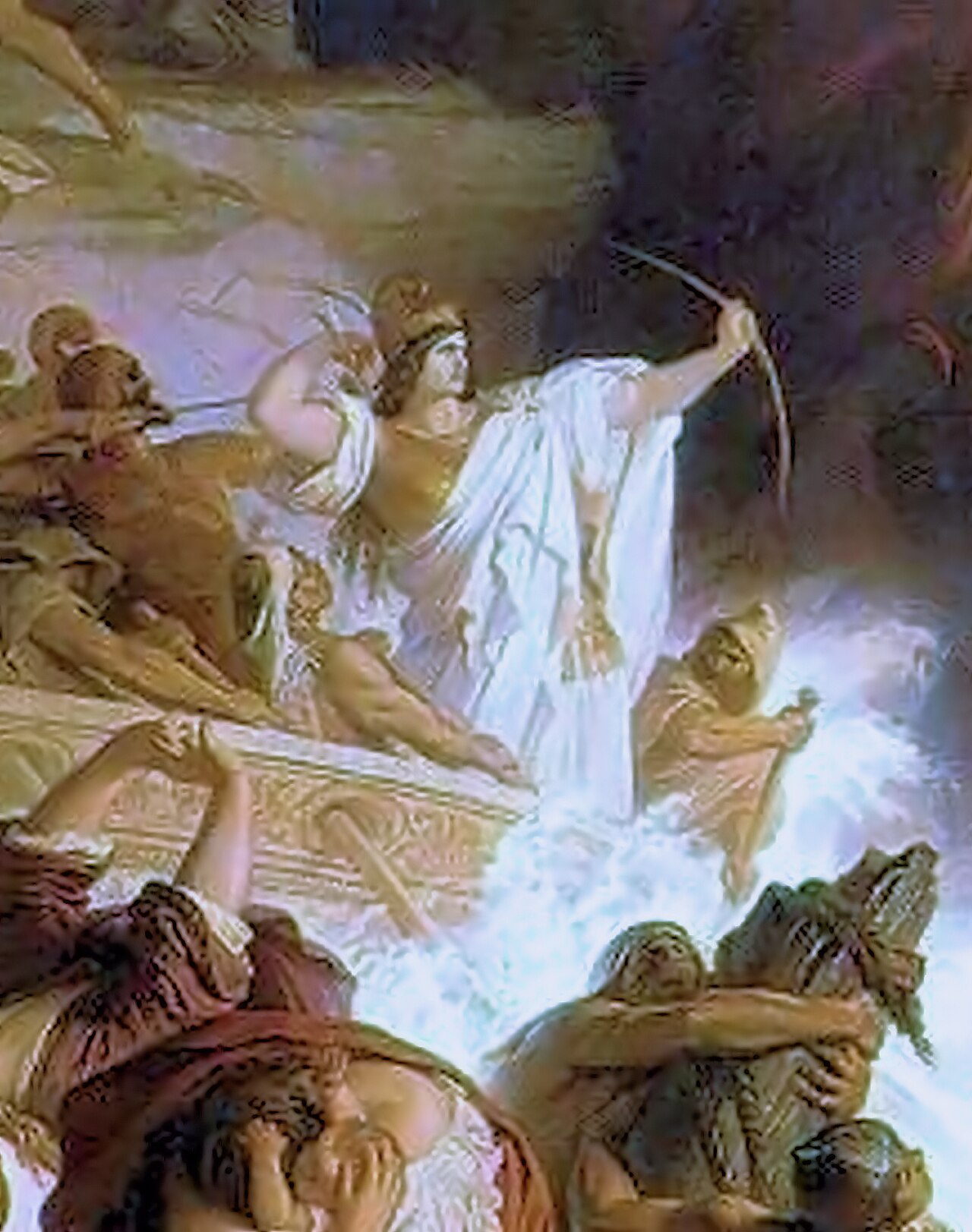
At dawn the Persian fleet, having spent the night at the oars, rowed into the strait. The Phoenician squadrons faced the Athenians on the western side, and the Ionians faced the Spartans and others on the eastern side. The Greeks backed water at first, then attacked. In the cramped channel the Persian ships, pressing forward from behind, collided with those in front and could not turn. The heavier Greek triremes rammed them, and Greek marines boarded.
Herodotus names few details of the fighting, which he admits was confused. The Persian admiral Ariabignes, a son of Darius and brother of Xerxes, was killed. Many Persian sailors drowned because, Herodotus says, they could not swim, while Greeks whose ships sank swam to Salamis. In one famous scene Artemisia, pursued by an Athenian ship, escaped by ramming a ship from her own side. Xerxes, watching from a throne at the foot of Mount Aegaleos with scribes recording who fought well, is said to have taken it for an enemy ship and exclaimed that his men had become women and his women men.
Xerxes blamed the Phoenicians, and when some of their captains accused the Ionians of treachery, he had the Phoenicians beheaded instead. Late in the day Aristides landed Athenian hoplites on Psyttaleia and killed the Persian troops stationed there. Aeschylus, who fought in the battle according to later tradition, describes this slaughter as one of the worst blows to Persian pride.
Numbers and losses
Ancient figures for Salamis are as uncertain as for the rest of the campaign. Aeschylus gives the Persians 1,207 ships, the same number Herodotus gives for the start of the campaign, though storms and Artemisium had certainly reduced it. Modern historians usually estimate between about 500 and 800 Persian ships at Salamis, against some 310 to 380 Greek ships. Diodorus, writing four centuries later, says the Greeks lost about 40 ships and the Persians more than 200. No Persian source records the battle, so there is no independent check.
Xerxes returns to Asia
After the defeat Xerxes could no longer use his fleet to outflank the Greek wall at the Isthmus, and the fleet that remained withdrew to the coast of Asia Minor. Herodotus says Xerxes feared that the Greeks would sail to the Hellespont and break his bridges. He went back to Sardis with part of the army, leaving Mardonius in Greece with a large picked force. Herodotus tells this as a panicked flight, but it was sensible for the king not to spend another winter at the far edge of his empire. The war continued under Mardonius until Plataea in 479.
Two ways of telling it
For Greeks, and above all for Athenians, Salamis was the turning point of the war and the proof that their fleet had saved Greece. That view shaped the later Athenian empire, built on naval power. It also shaped the earliest account: Aeschylus’s The Persians is set at the Persian court and shows the queen mother hearing of the defeat, a remarkably early attempt to imagine the enemy’s side, though it is written for an Athenian audience and full of Greek ideas about pride and punishment.
From the Persian side the loss was serious but limited. Xerxes kept his throne, his army in Greece was still intact, and the empire’s resources were barely touched. What Salamis really changed was the balance at sea in the Aegean, which over the next two decades shifted firmly to Athens. See The Achaemenid Navy, Women of the Achaemenid Court on Artemisia’s place among powerful women of the empire, and the Greco-Persian Wars overview.
Persian words from this page
| سالامیس | Sâlâmis | Salamis |
| آرتمیزیا | Ârtemiziyâ | Artemisia |
| هالیکارناسوس | Hâlikârnâsus | Halicarnassus |
| ملکه | malekeh | queen |
| دریاسالار | daryâsâlâr | admiral |
| شنا | shenâ | swimming |
Sources and further reading
- Aeschylus, The Persians (472 BCE).
- Herodotus, Histories, Book 8, chapters 40–120.
- Diodorus of Sicily, Library of History, Book 11.
- Barry Strauss, The Battle of Salamis: The Naval Encounter That Saved Greece, and Western Civilization (2004).
- J. F. Lazenby, The Defence of Greece, 490–479 BC (1993).
Want to learn Persian? Get the free Starter Pack
Get the 14-page printable Starter Pack (all 32 letters, a 7-day reading plan, 100 core words and 20 survival phrases) and a short 5-email course. Free.
More in The Achaemenid Empire (550–330 BCE)
- Achaemenes, Teispes and the Early Persian Kings of Anshan
- Cyrus the Great: Birth, Legends and Rise to Power
- Cyrus Conquers Lydia: Croesus and the Battle of Thymbra
- The Persian Conquest of Ionia and Asia Minor
- Cyrus Takes Babylon (539 BCE)
- The Cyrus Cylinder
- Cyrus and the Return of the Jews
- The Death of Cyrus and the Massagetae
- Pasargadae: Cyrus’s Capital and Tomb
- The Tomb of Cyrus through History
- Cambyses II
- Cambyses Conquers Egypt: The Battle of Pelusium
- Bardiya and Gaumata: The Usurper Question
- Darius the Great Takes the Throne
- The Great Revolts of 522–521 BCE
- The Behistun Inscription
- The Persian Conquest of the Indus Valley
- Darius’s Scythian Campaign
- Darius’s Canal from the Nile to the Red Sea
- Darius’s Reforms: Satrapies, Taxes and Law
- The Royal Road and the Persian Postal System
- The Daric: Achaemenid Coinage and Economy
- The Ionian Revolt (499–493 BCE)
- The Greco-Persian Wars: An Overview
- Mardonius and the First Persian Expedition to Greece (492 BCE)
- The Battle of Marathon (490 BCE)
- The Death of Darius I and the Succession of Xerxes
- The Royal Tombs of Naqsh-e Rostam
- Xerxes I: King of Kings (486–465 BCE)
- Xerxes’ Invasion of Greece (480–479 BCE)
- The Battle of Thermopylae (480 BCE)
- The Battle of Artemisium (480 BCE)
- The Persian Capture of Athens (480–479 BCE)
- The Battle of Salamis (480 BCE)
- The Battle of Plataea and the End of the Invasion (479 BCE)
- The Palace of Darius at Susa
- Building Persepolis: How Darius and Xerxes Built Parsa
- The Persepolis Fortification and Treasury Tablets
- Herodotus and the Persians
- The Apadana Reliefs: Nations Bringing Gifts
- The Achaemenid Paradise Gardens
- The Persian Immortals and the Achaemenid Army
- The Achaemenid Navy
- Religion of the Achaemenid Kings
- Women of the Achaemenid Court
- Old Persian Language and Cuneiform
- Egypt under Persian Rule
- Babylon under Persian Rule
- Artaxerxes I
- The Peace of Callias
- Darius II and the Peloponnesian War
- Famous Satraps of the Persian Empire
- Artaxerxes II Mnemon
- Cyrus the Younger and the Battle of Cunaxa
- The King’s Peace (387 BCE)
- The Great Satraps’ Revolt
- Artaxerxes III and the Reconquest of Egypt
- Darius III, the Last Achaemenid King
- The Battle of the Granicus (334 BCE)
- The Battle of Issus (333 BCE)
- Alexander Takes Tyre, Gaza and Egypt (332 BCE)
- The Battle of Gaugamela (331 BCE)
- Ariobarzanes and the Battle of the Persian Gate
- The Burning of Persepolis (330 BCE)
- The Death of Darius III and Bessus
- The Legacy of the Achaemenid Empire