In 525 BCE the Persian king Cambyses II crossed the Sinai desert, defeated the pharaoh Psamtik III at Pelusium on the eastern edge of the Nile Delta and then took Memphis, ending the 26th Dynasty. Egypt became a Persian province for more than a century, and the campaign gave the empire its richest African territory. Most of the colourful detail comes from Herodotus, Book 3, and much of it has to be read with care.
| Date | 525 BCE (spring is often proposed; the exact month is not recorded) |
|---|---|
| Place | Pelusium, at the easternmost mouth of the Nile, then Memphis |
| Persian side | Cambyses II, with Phoenician, Cypriot and Ionian ships |
| Egyptian side | Psamtik III, son of Amasis, with Greek and Carian mercenaries |
| Result | Persian victory; Egypt becomes a satrapy (the “27th Dynasty” of later Egyptian king lists) |
| Main source | Herodotus, Histories 3.1–16 |
Why Egypt, and why 525
After Cyrus took Babylon in 539 BCE, Egypt was the last great kingdom of the Near East outside Persian control. Its pharaoh Amasis (Ahmose II) had been an ally of Croesus of Lydia, whom Cyrus had already destroyed, and he had built up ties with Greek states and with Polycrates, the tyrant of Samos. An attack was a matter of time.
Herodotus offers several stories for the cause: that Cambyses asked for an Egyptian princess and was sent a substitute, or that he was the son of an Egyptian woman and was taking revenge. Even Herodotus did not quite believe these. Imperial logic is a better explanation: Egypt was rich in grain and gold, and it lay at the end of the coastal road from Syria that Persia already controlled.
Timing helped. Amasis died in 526 BCE after a reign of about 44 years, and his son Psamtik III had been on the throne only a few months when the Persians arrived. The page on Cambyses II covers the king himself and the navy he built for this campaign.

Crossing the desert
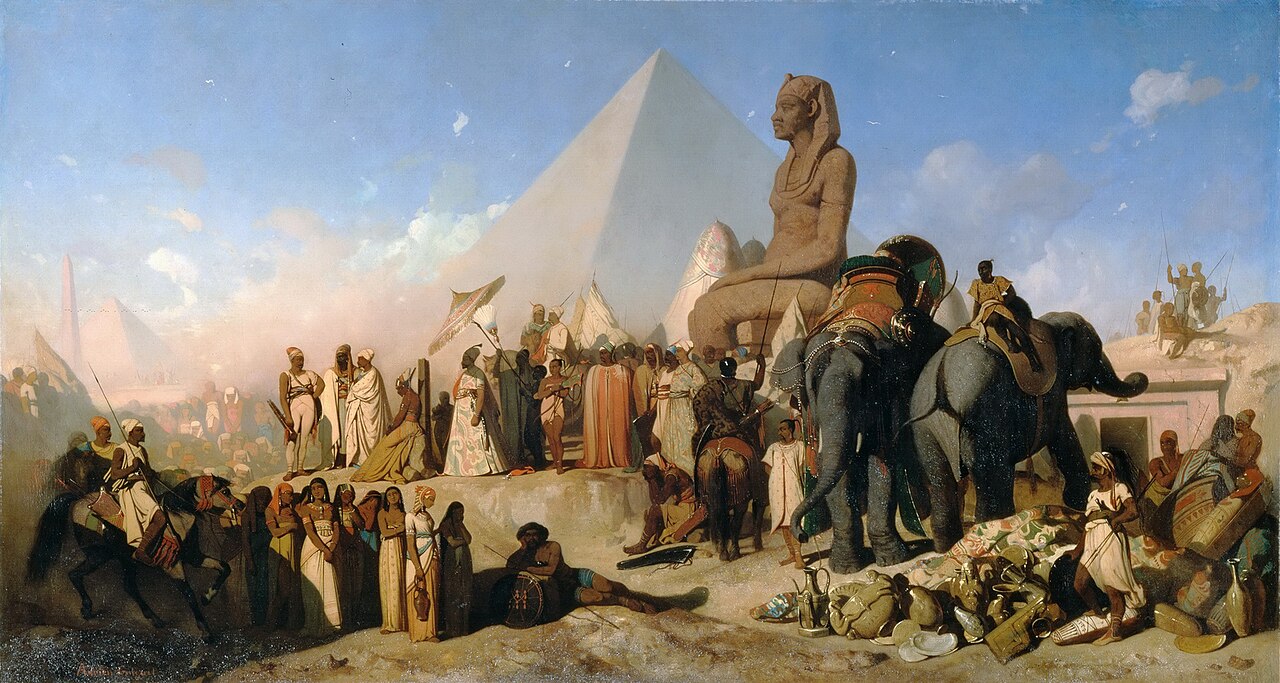
An army coming from Gaza had to cross about three days of waterless desert along the north coast of Sinai. Herodotus says Cambyses solved this by making a pact with an Arab king, who sent camels loaded with water skins to meet the army. He also reports a less likely version in which the Arabs piped water from a distant river through tubes of oxhide.
Two defections made the invasion easier. Phanes of Halicarnassus, a commander of Amasis’s Greek mercenaries, fled to Persia and, Herodotus says, advised Cambyses on the route and on the Egyptian defences. And Polycrates of Samos, who had been friendly to Egypt, changed sides and sent forty triremes to join the Persian fleet, manned with Samians he wanted rid of. The fleet, mostly Phoenician and Cypriot, mattered because Pelusium lay where land and sea routes met.
The battle at Pelusium
Psamtik III waited for the Persians at the Pelusiac mouth of the Nile. Herodotus’s account of the battle itself is short. Before it began, the Greek and Carian mercenaries on the Egyptian side took revenge on Phanes, whose sons had stayed behind in Egypt: they killed the boys in front of the Persian lines, mixed their blood with wine and water in a bowl and drank it. Then the armies met, and after heavy losses on both sides the Egyptians broke and fled.
Herodotus adds a detail from his own travels about seventy years later. He says the bones still lay on the battlefield in two heaps, Persian and Egyptian, and that the Egyptian skulls were so thick a stone could hardly crack them, while the Persian skulls broke at a tap. He explained this by Egyptians shaving their heads in the sun and Persians wearing felt caps. It is a good example of how he mixed observation with theory.
The story of the cats
A popular modern story says Cambyses won by placing cats, dogs and other animals sacred to the Egyptians in front of his troops, so the Egyptians would not shoot. This comes from Polyaenus, a Macedonian writer of the 2nd century CE, some 700 years after the battle, and it is not in Herodotus. Most historians treat it as legend.
The siege of Memphis and the fate of Psamtik
The defeated army fell back to Memphis, the old capital near modern Cairo. Cambyses sent a ship from Mytilene up the Nile with a herald to demand surrender. The Egyptians destroyed the ship and killed the crew. After a siege the city fell, and Psamtik was captured.
Herodotus then tells one of the most famous scenes in his book. On the tenth day after the fall of Memphis, Cambyses tested the captured pharaoh. Psamtik watched his daughter pass by dressed as a slave, carrying water, and his son led out to execution with two thousand young Egyptians, and he did not weep. But when he saw an old friend reduced to begging, he wept. Asked why, he answered that his own griefs were too great for tears. Cambyses, moved, spared him. Herodotus says Psamtik was later caught plotting a revolt and forced to drink bull’s blood, which killed him. The scene is a moral tale, and no Egyptian source confirms it, but it shows how Greeks of the 5th century imagined the encounter.
Libya, Cyrene and beyond
The fall of Memphis brought quick submissions from the west. The Libyans sent gifts, and so did the Greek cities of Cyrene and Barca on the coast of modern Libya. Herodotus says Cambyses scattered Cyrene’s gift of 500 minas of silver among his troops as too small. Further plans against Carthage, the oasis of Siwa and the kingdom of Kush failed or were dropped; these are discussed on the Cambyses II page.
The Apis bull: how reliable is Herodotus?
Herodotus claims that Cambyses, returning from his failed southern march, found Memphis celebrating the appearance of a new Apis bull, thought they were mocking his defeat, and stabbed the bull in the thigh, after which it died. For Herodotus this was the start of the king’s madness.
The evidence from the Serapeum, the burial place of the Apis bulls at Saqqara, points the other way. An inscribed sarcophagus and a stela record an Apis buried with full honours in Cambyses’s sixth regnal year, with the king shown kneeling before the bull. The next bull’s epitaph indicates it was born under Cambyses and died under Darius. Some scholars try to fit Herodotus into the gaps between these dates, but most read the story as hostile priestly gossip, perhaps fed by Cambyses’s cuts to temple income. The Egyptian official Udjahorresnet, whose statue inscription is the best Egyptian witness, describes Cambyses taking a pharaoh’s titles and honouring the goddess Neith at Sais.
Egypt as a Persian province
Cambyses ruled Egypt as pharaoh, with Egyptian titles, and placed a Persian satrap, Aryandes, at Memphis. Persian rule lasted until about 404 BCE, then returned briefly under Artaxerxes III. The next king to leave a strong mark there was Darius, who completed a canal from the Nile to the Red Sea. Cambyses himself never saw Persia again: the news of a rival king at home, told on Bardiya and Gaumata, reached him in 522 BCE.
Persian words from this page
| کمبوجیه | Kambujiye | Cambyses |
| مصر | Mesr | Egypt |
| فرعون | fer’oun | pharaoh |
| نیل | Nil | the Nile |
| سپاه | sepâh | army |
| گاو | gâv | cow, bull |
Sources and further reading
- Herodotus, Histories, Book 3, chapters 1–16 and 27–29.
- Polyaenus, Stratagems 7.9 (the late story of the animals).
- Pierre Briant, From Cyrus to Alexander: A History of the Persian Empire (2002), chapter 2.
- Amélie Kuhrt, The Persian Empire: A Corpus of Sources from the Achaemenid Period (2007), Udjahorresnet and Serapeum texts.
- Encyclopaedia Iranica, “Cambyses”.
Want to learn Persian? Get the free Starter Pack
Get the 14-page printable Starter Pack (all 32 letters, a 7-day reading plan, 100 core words and 20 survival phrases) and a short 5-email course. Free.
More in The Achaemenid Empire (550–330 BCE)
- Achaemenes, Teispes and the Early Persian Kings of Anshan
- Cyrus the Great: Birth, Legends and Rise to Power
- Cyrus Conquers Lydia: Croesus and the Battle of Thymbra
- The Persian Conquest of Ionia and Asia Minor
- Cyrus Takes Babylon (539 BCE)
- The Cyrus Cylinder
- Cyrus and the Return of the Jews
- The Death of Cyrus and the Massagetae
- Pasargadae: Cyrus’s Capital and Tomb
- The Tomb of Cyrus through History
- Cambyses II
- Cambyses Conquers Egypt: The Battle of Pelusium
- Bardiya and Gaumata: The Usurper Question
- Darius the Great Takes the Throne
- The Great Revolts of 522–521 BCE
- The Behistun Inscription
- The Persian Conquest of the Indus Valley
- Darius’s Scythian Campaign
- Darius’s Canal from the Nile to the Red Sea
- Darius’s Reforms: Satrapies, Taxes and Law
- The Royal Road and the Persian Postal System
- The Daric: Achaemenid Coinage and Economy
- The Ionian Revolt (499–493 BCE)
- The Greco-Persian Wars: An Overview
- Mardonius and the First Persian Expedition to Greece (492 BCE)
- The Battle of Marathon (490 BCE)
- The Death of Darius I and the Succession of Xerxes
- The Royal Tombs of Naqsh-e Rostam
- Xerxes I: King of Kings (486–465 BCE)
- Xerxes’ Invasion of Greece (480–479 BCE)
- The Battle of Thermopylae (480 BCE)
- The Battle of Artemisium (480 BCE)
- The Persian Capture of Athens (480–479 BCE)
- The Battle of Salamis (480 BCE)
- The Battle of Plataea and the End of the Invasion (479 BCE)
- The Palace of Darius at Susa
- Building Persepolis: How Darius and Xerxes Built Parsa
- The Persepolis Fortification and Treasury Tablets
- Herodotus and the Persians
- The Apadana Reliefs: Nations Bringing Gifts
- The Achaemenid Paradise Gardens
- The Persian Immortals and the Achaemenid Army
- The Achaemenid Navy
- Religion of the Achaemenid Kings
- Women of the Achaemenid Court
- Old Persian Language and Cuneiform
- Egypt under Persian Rule
- Babylon under Persian Rule
- Artaxerxes I
- The Peace of Callias
- Darius II and the Peloponnesian War
- Famous Satraps of the Persian Empire
- Artaxerxes II Mnemon
- Cyrus the Younger and the Battle of Cunaxa
- The King’s Peace (387 BCE)
- The Great Satraps’ Revolt
- Artaxerxes III and the Reconquest of Egypt
- Darius III, the Last Achaemenid King
- The Battle of the Granicus (334 BCE)
- The Battle of Issus (333 BCE)
- Alexander Takes Tyre, Gaza and Egypt (332 BCE)
- The Battle of Gaugamela (331 BCE)
- Ariobarzanes and the Battle of the Persian Gate
- The Burning of Persepolis (330 BCE)
- The Death of Darius III and Bessus
- The Legacy of the Achaemenid Empire