The Immortals were the elite guard infantry of the Achaemenid kings: according to Herodotus, a corps of 10,000 picked Persians whose numbers were kept full, so that whenever a man died or fell ill another took his place. They formed the core of a much larger royal army that combined Persian and Median troops, levies from every satrapy, garrisons and, increasingly, cavalry and hired Greek soldiers. Almost everything we know about the name comes from Greek writers; the Persian sources show the guard, but not the word.
| Name | Greek athanatoi, “the immortals” (Herodotus); modern Persian جاویدان (Jâvidân) |
|---|---|
| Size | 10,000 infantry, of whom 1,000 formed the king’s personal guard |
| Recruited from | Persians (and, on the reliefs, Medes and Elamites) |
| Weapons | Spear, bow, dagger, wicker shield; scale armour |
| Known commander | Hydarnes son of Hydarnes, under Xerxes (480 BCE) |
The Immortals’ part in the fighting of 480 BCE, their failed assault in the pass and the night march over the mountain path, is told on the page on the Battle of Thermopylae. This page looks at the corps itself and the army it belonged to.

What Herodotus says
Herodotus gives three short passages in Book 7 of his Histories, written about two generations after Xerxes’ invasion. In his catalogue of the army he describes the Persian infantry: felt caps, sleeved tunics of many colours, scale armour that looked like fish scales, trousers, wicker shields, short spears, long bows with reed arrows and a dagger hanging from the belt on the right thigh. Of all these Persians, he says, 10,000 were chosen men under Hydarnes, and they were called Immortals because their number never fell below 10,000.
He adds that they were the best equipped and the most splendid of the army, that they wore a great deal of gold, and that they travelled with carriages for their women and servants, with camels and pack animals carrying food reserved for them alone. In the order of march out of Sardis he places the 10,000 behind the king and his own spearmen and horsemen. In place of a butt spike, 1,000 of them had golden pomegranates on their spears and marched on the outside; the 9,000 inside had silver ones. The noble spearmen closest to the king carried golden apples.
The name: a misunderstanding?
No Persian text calls the guard “immortal”, and Greek writers after Herodotus rarely use the word for Persian troops. One proposal, often repeated, is that Herodotus or his informants confused two similar-sounding Persian words: anušiya, “companion” or “follower”, a word Darius uses at Behistun for the men loyal to him, and a word meaning “immortal”. The idea is attractive, but it is a guess, and Herodotus’s own explanation (a unit always kept at full strength) makes sense on its own.
The guards on the walls of Persepolis and Susa
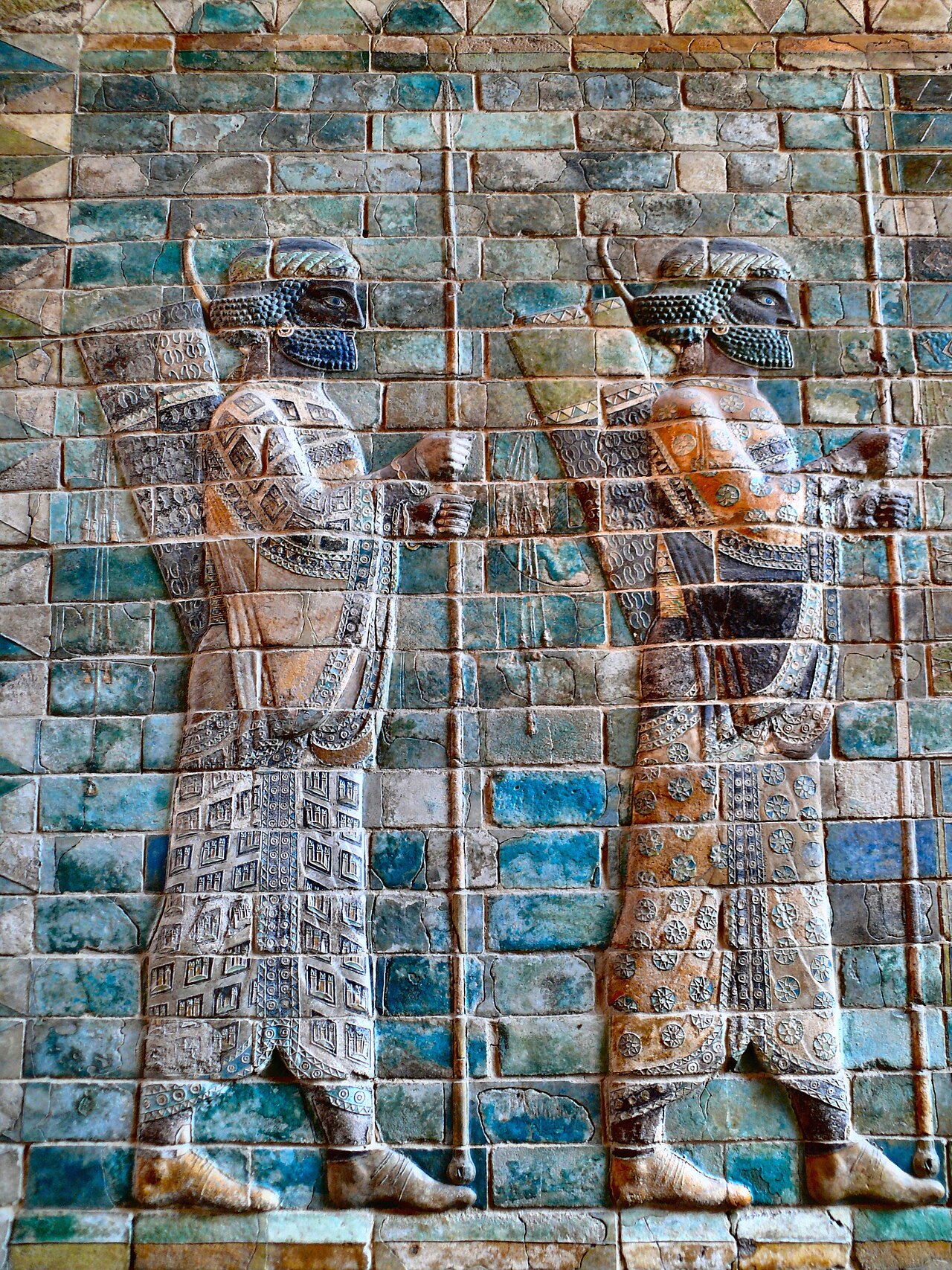
The Achaemenids carved and glazed their guards again and again. At Persepolis, rows of spearmen line the stairways, some in the pleated Persian robe and fluted hat, some in the Median riding coat and rounded cap, and many hold spears with a round counterweight at the base, the pomegranate or “apple” of the Greek accounts. At Susa, Darius’s palace was decorated with friezes of glazed brick showing life-size spearmen in richly patterned robes, a bow and quiver on the shoulder.
These Susa archers are often labelled “the Immortals” in museums and books. That may be right, but nothing on the friezes names them, and some scholars read them as an image of the royal guard in general or even of the Persian people under arms. The faces include both light and dark skin tones, which has led to suggestions that Elamites served alongside Persians in the guard.
Apple-bearers
Later Greek writers call the king’s closest guard the melophoroi, “apple-bearers”, after the golden fruit on their spears. Heraclides of Cyme, quoted by Athenaeus, describes 1,000 of them, all Persians, as the bodyguard around the king, and Arrian places the apple-bearers near Darius III at Gaugamela in 331 BCE. Their commander, the “chiliarch” or commander of the thousand, became one of the most powerful officials at court.
An army counted in tens
Herodotus and the Persepolis records both point to a decimal organisation: units of ten, a hundred, a thousand and ten thousand, each under its own commander. The Persian word for thousand survives in modern Persian as هزار (hezâr). The Immortals were the ten-thousand unit of the Persians themselves.
In Old Persian the word for the army is kāra, which also means “the people”. At Behistun Darius speaks of “the Persian and Median army that was with me”. The heart of the royal army was Iranian. Around it the king could call up contingents from every land, the long list of peoples that Herodotus gives for 480 BCE, each fighting in its own dress and with its own weapons.
Soldiers on the land
Between campaigns, the empire kept soldiers in garrisons: at Sardis, in Egypt, in Babylonia and at frontier posts such as Elephantine on the Nile, where Aramaic papyri record a garrison of Jewish soldiers in Persian service in the fifth century BCE. In Babylonia, the archive of the Murashu family shows land held as “bow land”, “horse land” and “chariot land”: plots granted to settlers who owed the king an archer, a horseman or the cost of a chariot when called. The system tied military service to farming and tax, and by the late fifth century much of it was paid in silver rather than in men.
Cavalry and the changing army
Herodotus says that Persian boys were taught three things from the age of five to twenty: to ride, to shoot the bow and to tell the truth. Horses were central to Persian status, and the royal herds of Nisaean horses from Media were famous. Cavalry played a decisive part at Plataea in 479 BCE, and in the fourth century it became the strongest arm of the royal army. Heavy horsemen from Bactria and other eastern lands, man and horse protected by armour, fought at Gaugamela.
The fourth century also brought two changes the Greek writers noticed. Scythed chariots, with blades on their wheels, were used at Cunaxa in 401 BCE and at Gaugamela. And Greek hoplites were hired in large numbers by kings, satraps and rebels alike; at the Granicus and Issus, Greek mercenaries formed much of the Persian infantry line. Xenophon’s eyewitness account of Cunaxa is the best description of a late Achaemenid army in action.
How historians judge the Persian army
Greek authors had reasons to paint the Persian infantry as brave but lightly armoured and outclassed by the hoplite, and the image of the Immortals in films and novels draws heavily on them. Modern historians point out that the same army conquered the lands from Egypt to the Indus in a single generation and held them for two centuries. Its weakness against Greek heavy infantry in close terrain was real, but it was one army facing one kind of enemy, not a measure of the whole.
The name in modern Iran
The name returned in the twentieth century. Under Mohammad Reza Shah, an elite unit of the Imperial Guard was called the Immortal Guard, گارد جاویدان (Gârd-e Jâvidân), a deliberate link to the Achaemenid past.
Persian words from this page
| جاویدان | jâvidân | immortal, eternal |
| هزار | hezâr | thousand |
| نیزه | neyzeh | spear |
| کمان | kamân | bow |
| سپر | separ | shield |
| اسب | asb | horse |
| انار | anâr | pomegranate |
Sources and further reading
- Herodotus, Histories, Book 7 (7.40–41, 7.61, 7.83) and Book 1.136.
- Arrian, Anabasis of Alexander, Book 3, on Gaugamela.
- Encyclopaedia Iranica, “Army i. Pre-Islamic Iran”.
- Pierre Briant, From Cyrus to Alexander: A History of the Persian Empire (2002).
- Duncan Head, The Achaemenid Persian Army (Stockport, 1992).
Want to learn Persian? Get the free Starter Pack
Get the 14-page printable Starter Pack (all 32 letters, a 7-day reading plan, 100 core words and 20 survival phrases) and a short 5-email course. Free.
More in The Achaemenid Empire (550–330 BCE)
- Achaemenes, Teispes and the Early Persian Kings of Anshan
- Cyrus the Great: Birth, Legends and Rise to Power
- Cyrus Conquers Lydia: Croesus and the Battle of Thymbra
- The Persian Conquest of Ionia and Asia Minor
- Cyrus Takes Babylon (539 BCE)
- The Cyrus Cylinder
- Cyrus and the Return of the Jews
- The Death of Cyrus and the Massagetae
- Pasargadae: Cyrus’s Capital and Tomb
- The Tomb of Cyrus through History
- Cambyses II
- Cambyses Conquers Egypt: The Battle of Pelusium
- Bardiya and Gaumata: The Usurper Question
- Darius the Great Takes the Throne
- The Great Revolts of 522–521 BCE
- The Behistun Inscription
- The Persian Conquest of the Indus Valley
- Darius’s Scythian Campaign
- Darius’s Canal from the Nile to the Red Sea
- Darius’s Reforms: Satrapies, Taxes and Law
- The Royal Road and the Persian Postal System
- The Daric: Achaemenid Coinage and Economy
- The Ionian Revolt (499–493 BCE)
- The Greco-Persian Wars: An Overview
- Mardonius and the First Persian Expedition to Greece (492 BCE)
- The Battle of Marathon (490 BCE)
- The Death of Darius I and the Succession of Xerxes
- The Royal Tombs of Naqsh-e Rostam
- Xerxes I: King of Kings (486–465 BCE)
- Xerxes’ Invasion of Greece (480–479 BCE)
- The Battle of Thermopylae (480 BCE)
- The Battle of Artemisium (480 BCE)
- The Persian Capture of Athens (480–479 BCE)
- The Battle of Salamis (480 BCE)
- The Battle of Plataea and the End of the Invasion (479 BCE)
- The Palace of Darius at Susa
- Building Persepolis: How Darius and Xerxes Built Parsa
- The Persepolis Fortification and Treasury Tablets
- Herodotus and the Persians
- The Apadana Reliefs: Nations Bringing Gifts
- The Achaemenid Paradise Gardens
- The Persian Immortals and the Achaemenid Army
- The Achaemenid Navy
- Religion of the Achaemenid Kings
- Women of the Achaemenid Court
- Old Persian Language and Cuneiform
- Egypt under Persian Rule
- Babylon under Persian Rule
- Artaxerxes I
- The Peace of Callias
- Darius II and the Peloponnesian War
- Famous Satraps of the Persian Empire
- Artaxerxes II Mnemon
- Cyrus the Younger and the Battle of Cunaxa
- The King’s Peace (387 BCE)
- The Great Satraps’ Revolt
- Artaxerxes III and the Reconquest of Egypt
- Darius III, the Last Achaemenid King
- The Battle of the Granicus (334 BCE)
- The Battle of Issus (333 BCE)
- Alexander Takes Tyre, Gaza and Egypt (332 BCE)
- The Battle of Gaugamela (331 BCE)
- Ariobarzanes and the Battle of the Persian Gate
- The Burning of Persepolis (330 BCE)
- The Death of Darius III and Bessus
- The Legacy of the Achaemenid Empire