Cambyses II (Old Persian Kambūjiya) was the elder son of Cyrus the Great and king of Persia from 530 to 522 BCE. He built the first Persian navy and conquered Egypt in 525 BCE, extending the empire to Africa. Herodotus portrays him as a cruel madman, but Egyptian and Babylonian documents give a more ordinary picture, and his death in 522 BCE opened the most serious succession crisis in Achaemenid history.
| Reign | 530–522 BCE (also briefly “king of Babylon” under Cyrus in 538 BCE) |
|---|---|
| Parents | Cyrus II and Cassandane, an Achaemenid noblewoman |
| Brother | Bardiya (Smerdis in Herodotus) |
| Main achievement | Conquest of Egypt, 525 BCE |
| Egyptian royal name | Mesutira, “offspring of Ra” |
| Died | 522 BCE, in Syria according to Herodotus; the cause is disputed |
| Persian name | کمبوجیه Kambujiye |
Crown prince in Babylon
Cambyses was named after his grandfather, Cambyses I of Anshan. His mother, according to Herodotus, was Cassandane, whose death Cyrus mourned deeply. Cambyses was being prepared for the throne long before his father died. In 538 BCE, soon after the conquest of Babylon, Babylonian documents for about a year name him “king of Babylon” while Cyrus is “king of the lands”, and the Cyrus Cylinder ends with a prayer for both father and son.
When Cyrus marched against the Massagetae in 530 BCE, Herodotus says he sent Cambyses home as regent and formal heir. Cyrus died on that campaign, as told on The Death of Cyrus and the Massagetae, and Cambyses succeeded without opposition.
Building a navy
Cyrus had conquered by land. Egypt, the last great independent power of the Near East, could not be taken that way alone: an army had to cross the Sinai desert and be supplied by sea. Cambyses’s first great achievement was to create a fleet. The Phoenician cities of the Levant, which had come under Persian rule with Babylon’s provinces, provided the core. Cyprus submitted and added its ships, and Herodotus says Polycrates, tyrant of Samos, sent forty triremes. This was the beginning of the Achaemenid navy that would later fight at Salamis.
The conquest of Egypt
In 525 BCE Cambyses invaded. Arab tribes supplied water for the desert crossing, and a Greek mercenary commander, Phanes of Halicarnassus, defected to the Persians with knowledge of the Egyptian defences. The Persians defeated the army of the new pharaoh Psamtik III at Pelusium on the eastern edge of the Nile Delta, besieged Memphis and took the king prisoner. Libya and the Greek cities of Cyrene and Barca submitted. The campaign, and the reliability of the stories told about it, is covered on Cambyses Conquers Egypt: The Battle of Pelusium.
Cambyses then planned to go further. Herodotus says he intended to attack Carthage, the Ammonians at the oasis of Siwa and the Ethiopians (the kingdom of Kush on the upper Nile). The Phoenicians refused to sail against Carthage, their own colony. An army sent to Siwa, Herodotus claims, was buried by a sandstorm, and the march on Kush failed for lack of supplies. The lost army of Siwa is the kind of story that is hard to test; no trace of it has been found.
The mad king of Herodotus
Most of what Greeks believed about Cambyses comes from Herodotus, Book 3, and it is a portrait of a man destroyed by power. Herodotus says Cambyses suffered from the “sacred disease”, probably epilepsy, and lists his crimes:
- he stabbed the sacred Apis bull of Memphis in the thigh and mocked the Egyptian gods;
- he married two of his own sisters, against Persian custom by Herodotus’s account, and later killed the younger one;
- he shot the son of his courtier Prexaspes with an arrow to prove he was not drunk;
- he had twelve Persian nobles buried alive head down;
- after a dream, he had his brother Bardiya secretly murdered.
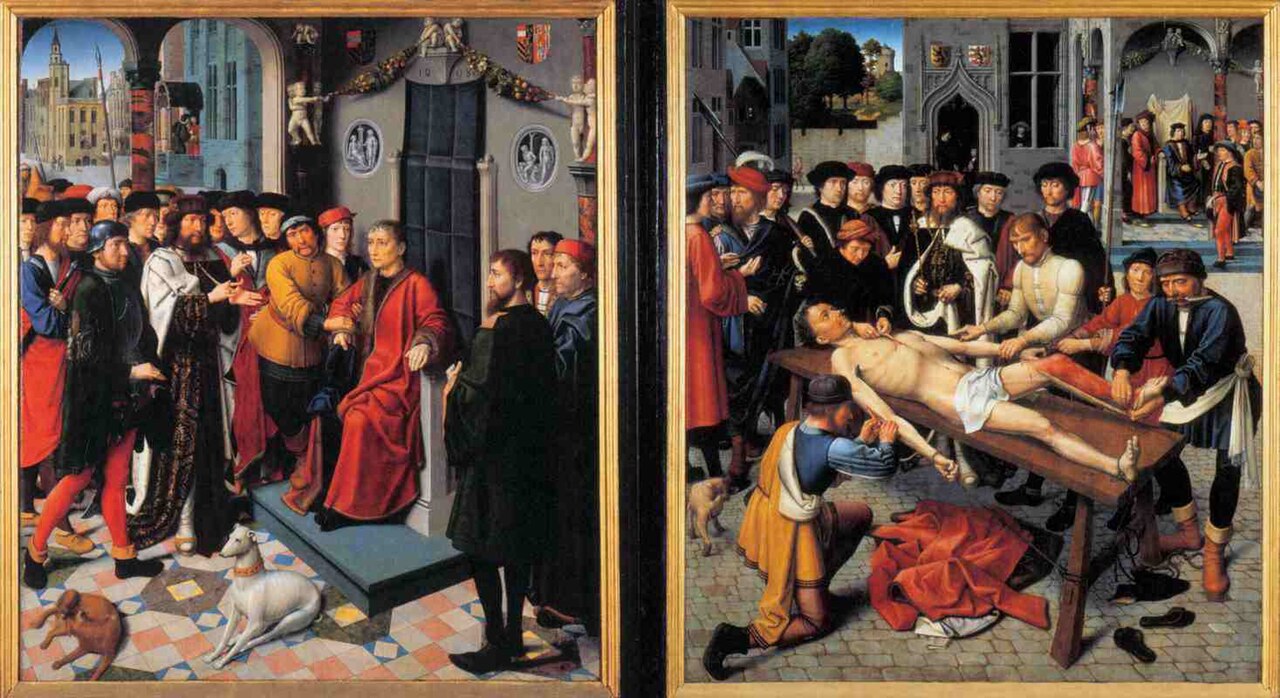
Herodotus also tells the story shown in the painting above. A royal judge named Sisamnes took a bribe, so Cambyses had him flayed, used his skin to cover the judgment seat, and appointed the judge’s son in his place, ordering him to remember what he sat on. Herodotus also reports a Persian saying that Darius was a shopkeeper, Cambyses a master and Cyrus a father.

The view from Egypt and Babylon
Other sources make the Herodotus portrait hard to accept as it stands.
A statue now in the Vatican Museums carries the autobiography of Udjahorresnet, an Egyptian admiral and priest who served Cambyses. He says Cambyses took the royal name Mesutira, “offspring of Ra”, honoured the goddess Neith at Sais, expelled foreign soldiers who had camped in her temple and restored its revenues. Records from the Serapeum at Memphis show that an Apis bull that died during Cambyses’s reign was buried with full honours, with a stela showing the king kneeling before the bull. That makes the story of Cambyses killing the Apis doubtful, although historians still debate the dates of the bulls involved.
Cambyses did cut the income of many Egyptian temples, according to a later Egyptian document, and that probably earned him the hostility of Egyptian priests. Greek visitors to Egypt in Herodotus’s time heard their stories. Many historians, including Pierre Briant, conclude that the “mad Cambyses” was largely a creation of Egyptian resentment and of later Persian propaganda under Darius, whose own claim to the throne depended on making Cambyses’s reign end in disaster.
The death of Cambyses
In 522 BCE, while Cambyses was in Egypt or on his way home, a man claiming to be his brother Bardiya seized power in Iran. Cambyses set out to deal with him but died before he could.
The accounts of his death disagree:
- Herodotus (3.64–66): at a town called Agbatana in Syria, as Cambyses mounted his horse, the cap of his sword scabbard fell off and the blade pierced his thigh, in the same place where he had struck the Apis. The wound turned gangrenous and he died about twenty days later, without children, after confessing that he had killed his brother.
- The Behistun inscription: Darius says only that Cambyses “died his own death”. The Old Persian phrase has been read as meaning a natural death, an accident, or suicide, and scholars still argue over it.
- Ctesias: Cambyses died at Babylon, eleven days after wounding himself in the thigh while carving a piece of wood.
His burial place is unknown. An unfinished royal tomb near Persepolis, known as Takht-e Rostam, and a ruined stone platform at Pasargadae have both been suggested as his intended tomb.
Succession and crisis
Cambyses died without a son, and the throne passed, for some months, to the man who called himself Bardiya. Darius, a member of the royal clan but not a son of Cyrus, killed him in September 522 BCE and declared him an impostor, a Magian named Gaumata. Whether the murdered king was really Bardiya is one of the great puzzles of the period, discussed on Bardiya and Gaumata: The Usurper Question. Darius then married Cambyses’s sister Atossa, who would become the mother of Xerxes.
Cambyses’s eight years gave the empire a navy and brought Egypt under Persian rule for more than a century, a story continued on Egypt under Persian Rule. For his father’s reign, see the site’s article on Cyrus the Great.
Persian words from this page
| کمبوجیه | Kambujiye | Cambyses |
| کاساندان | Kâsândân | Cassandane |
| بردیا | Bardiyâ | Bardiya |
| آتوسا | Âtusâ | Atossa |
| مصر | Mesr | Egypt |
| قاضی | ghâzi | judge |
| دیوانه | divâne | mad, insane |
Sources and further reading
- Herodotus, Histories 2.1, 3.1–66 and 5.25.
- The Behistun inscription of Darius I, column I §§10–11.
- The inscription of Udjahorresnet (Vatican Museums), translated in A. Kuhrt, The Persian Empire: A Corpus of Sources from the Achaemenid Period (Routledge, 2007).
- Ctesias, Persica, in L. Llewellyn-Jones and J. Robson, Ctesias’ History of Persia (Routledge, 2010).
- Pierre Briant, From Cyrus to Alexander: A History of the Persian Empire (Eisenbrauns, 2002), chapter 2.
- Encyclopaedia Iranica, “Cambyses II”.
Want to learn Persian? Get the free Starter Pack
Get the 14-page printable Starter Pack (all 32 letters, a 7-day reading plan, 100 core words and 20 survival phrases) and a short 5-email course. Free.
More in The Achaemenid Empire (550–330 BCE)
- Achaemenes, Teispes and the Early Persian Kings of Anshan
- Cyrus the Great: Birth, Legends and Rise to Power
- Cyrus Conquers Lydia: Croesus and the Battle of Thymbra
- The Persian Conquest of Ionia and Asia Minor
- Cyrus Takes Babylon (539 BCE)
- The Cyrus Cylinder
- Cyrus and the Return of the Jews
- The Death of Cyrus and the Massagetae
- Pasargadae: Cyrus’s Capital and Tomb
- The Tomb of Cyrus through History
- Cambyses II
- Cambyses Conquers Egypt: The Battle of Pelusium
- Bardiya and Gaumata: The Usurper Question
- Darius the Great Takes the Throne
- The Great Revolts of 522–521 BCE
- The Behistun Inscription
- The Persian Conquest of the Indus Valley
- Darius’s Scythian Campaign
- Darius’s Canal from the Nile to the Red Sea
- Darius’s Reforms: Satrapies, Taxes and Law
- The Royal Road and the Persian Postal System
- The Daric: Achaemenid Coinage and Economy
- The Ionian Revolt (499–493 BCE)
- The Greco-Persian Wars: An Overview
- Mardonius and the First Persian Expedition to Greece (492 BCE)
- The Battle of Marathon (490 BCE)
- The Death of Darius I and the Succession of Xerxes
- The Royal Tombs of Naqsh-e Rostam
- Xerxes I: King of Kings (486–465 BCE)
- Xerxes’ Invasion of Greece (480–479 BCE)
- The Battle of Thermopylae (480 BCE)
- The Battle of Artemisium (480 BCE)
- The Persian Capture of Athens (480–479 BCE)
- The Battle of Salamis (480 BCE)
- The Battle of Plataea and the End of the Invasion (479 BCE)
- The Palace of Darius at Susa
- Building Persepolis: How Darius and Xerxes Built Parsa
- The Persepolis Fortification and Treasury Tablets
- Herodotus and the Persians
- The Apadana Reliefs: Nations Bringing Gifts
- The Achaemenid Paradise Gardens
- The Persian Immortals and the Achaemenid Army
- The Achaemenid Navy
- Religion of the Achaemenid Kings
- Women of the Achaemenid Court
- Old Persian Language and Cuneiform
- Egypt under Persian Rule
- Babylon under Persian Rule
- Artaxerxes I
- The Peace of Callias
- Darius II and the Peloponnesian War
- Famous Satraps of the Persian Empire
- Artaxerxes II Mnemon
- Cyrus the Younger and the Battle of Cunaxa
- The King’s Peace (387 BCE)
- The Great Satraps’ Revolt
- Artaxerxes III and the Reconquest of Egypt
- Darius III, the Last Achaemenid King
- The Battle of the Granicus (334 BCE)
- The Battle of Issus (333 BCE)
- Alexander Takes Tyre, Gaza and Egypt (332 BCE)
- The Battle of Gaugamela (331 BCE)
- Ariobarzanes and the Battle of the Persian Gate
- The Burning of Persepolis (330 BCE)
- The Death of Darius III and Bessus
- The Legacy of the Achaemenid Empire