Naqsh-e Rostam is a cliff in Fars, about six kilometres north-west of Persepolis, where four Achaemenid kings were buried in tombs cut high into the rock in the 5th century BCE. Only one tomb, that of Darius I (died 486 BCE), names its owner; the other three are usually given to Xerxes I, Artaxerxes I and Darius II. Darius’s inscriptions there are among the most personal statements any Persian king left.
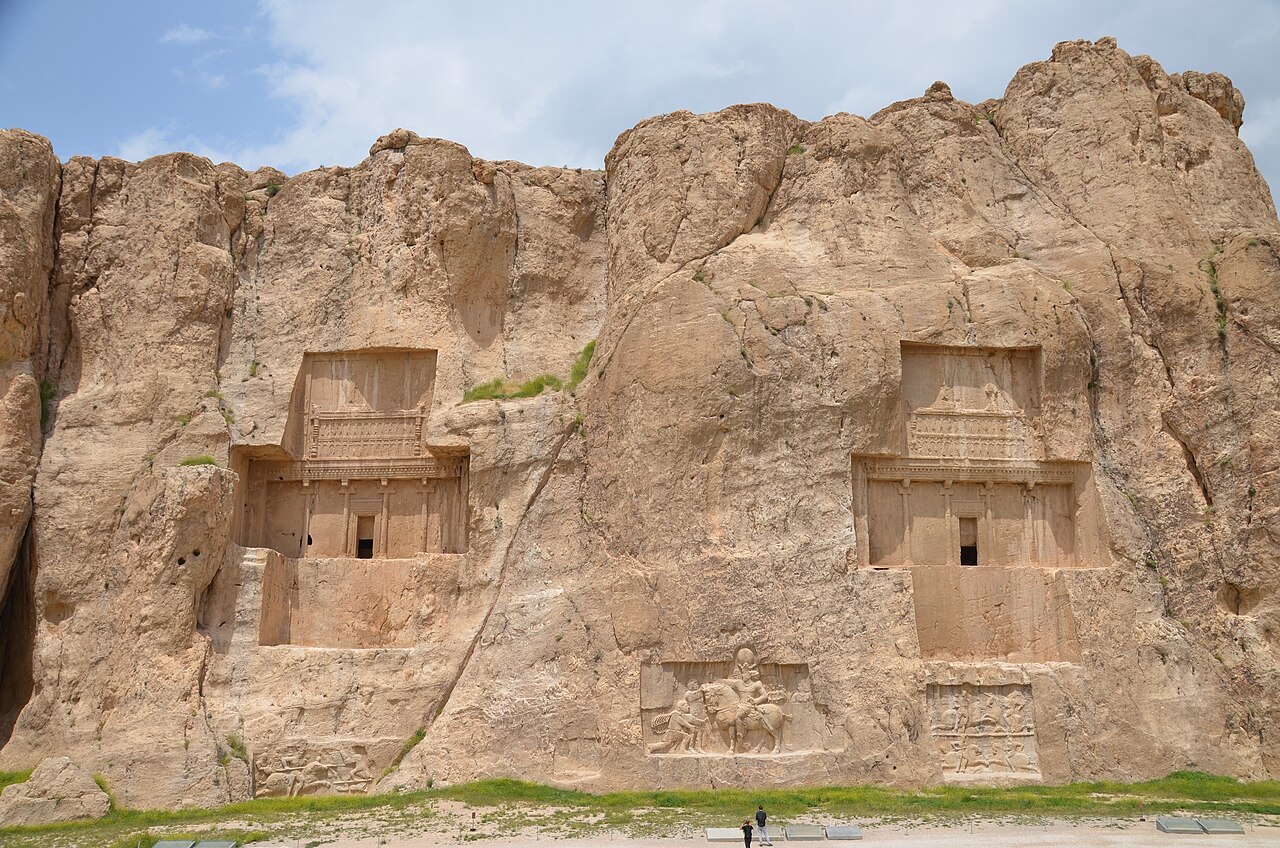

| Place | Hossein Kuh cliff, Marvdasht plain, Fars province |
|---|---|
| Date | Darius’s tomb begun in his lifetime (reigned 522–486 BCE); the others in the 5th century BCE |
| Tombs | Four, from left to right: Darius II, Artaxerxes I, Darius I, Xerxes I (only Darius I certain) |
| Inscriptions | DNa, DNb (Darius’s statements), DNc, DNd (labels of two nobles), DNe (labels of the throne-bearers) |
| Persian name | نقش رستم, “picture of Rostam” |
A new kind of royal grave
Cyrus the Great had been buried in a free-standing stone house on a stepped platform at Pasargadae. Darius chose something completely different. He had his tomb cut into a sheer limestone face, well above the ground, where no one could reach it without ropes or scaffolding. The choice may owe something to older rock-cut tombs in western Iran and to the Elamites, whose own relief, much worn, had already been carved on the same cliff centuries earlier. Whatever the inspiration, every king after Darius whose grave we can identify followed his model rather than Cyrus’s.
Why Darius broke with the founder is not known. One suggestion is that a new line needed a new burial ground: Darius came from a different branch of the family than Cyrus, and by placing his tomb close to his new palace city of Persepolis he tied the dynasty’s memory to his own foundations. On the story of how he took the throne, see Darius the Great takes the throne.
What the facade shows
Each tomb front is cut in the shape of a huge cross. The horizontal arm reproduces the front of a palace, with four columns topped by double bull capitals, a cornice and a doorway in the middle. The doorway is the real entrance: behind it a narrow vestibule leads to vaulted recesses holding stone burial cists, which were robbed long ago.
The upper arm carries the scene that matters most. The king stands on a three-stepped pedestal, raising one hand towards a fire altar. Above him floats the winged figure usually read as Ahura Mazda, and a moon symbol. The whole platform he stands on is a throne, lifted by two tiers of figures. On Darius’s tomb these bearers, about thirty of them, wear the dress of the peoples of the empire, and short labels (DNe) name them: Persian, Mede, Elamite, Babylonian, Egyptian, Indian and so on. The image turns the empire into a single structure held up by its subjects, with the king on top answering only to his god.
Darius speaks: the DNa and DNb inscriptions
Darius’s tomb carries two long texts in Old Persian, Elamite and Akkadian. The first, known to scholars as DNa, opens with praise of Ahura Mazda, “who created this earth”, gives the king’s titles and lists the lands he held. It then addresses the reader directly, in a passage that explains the relief: if you wonder how many lands King Darius held, look at the figures who carry the throne. It boasts that the spear of a Persian man has gone far, and that a Persian man fought battles far from Persia.
The second, DNb, is unusual in the ancient Near East. It is not about conquest but about character. The king says he is a friend to right and not to wrong, that he does not want the weak to be harmed by the strong, that he is not hot-tempered and keeps firm control of his anger. He then lists his physical skills as a rider, archer and spearman. Xerxes later had an almost identical text carved at Persepolis under his own name, which shows that this was a formula of kingship as much as a personal confession. The other two small inscriptions, DNc and DNd, label two nobles shown at the side of the facade: Gobryas, the king’s spear-bearer, and Aspathines, who carries his bow case. Gobryas was one of the six men who helped Darius seize power according to the Behistun inscription.
The other three tombs
None of the other facades has an inscription naming its owner, so attribution rests on style, position and the order of reigns. The usual identification, worked out by the excavator Erich Schmidt and others, puts Xerxes I to the right of Darius, and Artaxerxes I and Darius II further to the left. These are reasonable guesses, not certainties. The facades are almost exact copies of Darius’s, a sign of how much the later kings wanted to present themselves as his heirs.
The series did not continue at Naqsh-e Rostam. Artaxerxes II and Artaxerxes III were buried in similar tombs cut into the hill directly behind Persepolis, and an unfinished tomb south of the terrace is often linked with the last king, Darius III, who never used it. Darius III’s own fate is told on the death of Darius III.
Ctesias and the story of the ropes
Greek writers tell one anecdote about the tomb. Ctesias, a Greek doctor at the Persian court around 400 BCE, says that Darius wished to see the tomb being prepared for him but was talked out of climbing up. His parents went instead, hauled up on ropes by priests, who were frightened by snakes and let go, so that both fell to their deaths. Ctesias is a colourful and often unreliable writer, and nothing else confirms the story. It does at least show that Greeks knew the tombs were reached only with great difficulty.
The tower and the later reliefs
Facing the cliff stands a square stone tower, the Ka’ba-ye Zartosht (“Cube of Zoroaster”), built in the Achaemenid period. Its purpose is still argued over: a fire temple, a storehouse for sacred texts or royal insignia, or a tomb have all been suggested. Under Shapur I in the 3rd century CE the Sasanians carved a long trilingual account of his wars on its walls, covered on the Ka’ba-ye Zartosht inscription of Shapur I.
The Sasanians chose this cliff on purpose. Below the Achaemenid tombs they carved their own reliefs of investiture and victory, including Shapur’s triumph over Roman emperors, linking themselves visually to the old kings of Persis. These are described on the Sasanian reliefs of Naqsh-e Rostam. Centuries later, local people no longer knew who the carved horsemen were and connected them with Rostam, the hero of the Shahnameh, which gave the site its modern name.
Why the tombs matter to historians
The tombs show what an Achaemenid king wanted to be remembered for: piety towards Ahura Mazda, mastery over many peoples who willingly carry him, and personal virtue. Because the throne-bearers are labelled, the reliefs are also one of the best visual sources for how the Persians themselves classified the peoples of their empire, a useful check on the lists in Greek writers such as Herodotus. For a visitor’s description of the site today, see Naqsh-e Rostam in our places section, and for the nearby palace city, our article on Persepolis.
Persian words from this page
| نقش رستم | Naghsh-e Rostam | “picture of Rostam”, the site |
| آرامگاه | ârâmgâh | tomb, resting place |
| داریوش | Dâriush | Darius |
| خشایارشا | Khashâyârshâ | Xerxes |
| اردشیر | Ardeshir | Artaxerxes |
| کعبه زرتشت | Ka’be-ye Zartosht | Cube of Zoroaster |
Sources and further reading
- Darius I, inscriptions DNa–DNe, in R. G. Kent, Old Persian: Grammar, Texts, Lexicon (1953), and A. Kuhrt, The Persian Empire: A Corpus of Sources from the Achaemenid Period (2007).
- Erich F. Schmidt, Persepolis III: The Royal Tombs and Other Monuments (Oriental Institute Publications 70, 1970).
- Encyclopaedia Iranica, “Naqš-e Rostam”.
- Pierre Briant, From Cyrus to Alexander: A History of the Persian Empire (2002).
- Ctesias, Persica, in L. Llewellyn-Jones and J. Robson, Ctesias’ History of Persia (2010).
Want to learn Persian? Get the free Starter Pack
Get the 14-page printable Starter Pack (all 32 letters, a 7-day reading plan, 100 core words and 20 survival phrases) and a short 5-email course. Free.
More in The Achaemenid Empire (550–330 BCE)
- Achaemenes, Teispes and the Early Persian Kings of Anshan
- Cyrus the Great: Birth, Legends and Rise to Power
- Cyrus Conquers Lydia: Croesus and the Battle of Thymbra
- The Persian Conquest of Ionia and Asia Minor
- Cyrus Takes Babylon (539 BCE)
- The Cyrus Cylinder
- Cyrus and the Return of the Jews
- The Death of Cyrus and the Massagetae
- Pasargadae: Cyrus’s Capital and Tomb
- The Tomb of Cyrus through History
- Cambyses II
- Cambyses Conquers Egypt: The Battle of Pelusium
- Bardiya and Gaumata: The Usurper Question
- Darius the Great Takes the Throne
- The Great Revolts of 522–521 BCE
- The Behistun Inscription
- The Persian Conquest of the Indus Valley
- Darius’s Scythian Campaign
- Darius’s Canal from the Nile to the Red Sea
- Darius’s Reforms: Satrapies, Taxes and Law
- The Royal Road and the Persian Postal System
- The Daric: Achaemenid Coinage and Economy
- The Ionian Revolt (499–493 BCE)
- The Greco-Persian Wars: An Overview
- Mardonius and the First Persian Expedition to Greece (492 BCE)
- The Battle of Marathon (490 BCE)
- The Death of Darius I and the Succession of Xerxes
- The Royal Tombs of Naqsh-e Rostam
- Xerxes I: King of Kings (486–465 BCE)
- Xerxes’ Invasion of Greece (480–479 BCE)
- The Battle of Thermopylae (480 BCE)
- The Battle of Artemisium (480 BCE)
- The Persian Capture of Athens (480–479 BCE)
- The Battle of Salamis (480 BCE)
- The Battle of Plataea and the End of the Invasion (479 BCE)
- The Palace of Darius at Susa
- Building Persepolis: How Darius and Xerxes Built Parsa
- The Persepolis Fortification and Treasury Tablets
- Herodotus and the Persians
- The Apadana Reliefs: Nations Bringing Gifts
- The Achaemenid Paradise Gardens
- The Persian Immortals and the Achaemenid Army
- The Achaemenid Navy
- Religion of the Achaemenid Kings
- Women of the Achaemenid Court
- Old Persian Language and Cuneiform
- Egypt under Persian Rule
- Babylon under Persian Rule
- Artaxerxes I
- The Peace of Callias
- Darius II and the Peloponnesian War
- Famous Satraps of the Persian Empire
- Artaxerxes II Mnemon
- Cyrus the Younger and the Battle of Cunaxa
- The King’s Peace (387 BCE)
- The Great Satraps’ Revolt
- Artaxerxes III and the Reconquest of Egypt
- Darius III, the Last Achaemenid King
- The Battle of the Granicus (334 BCE)
- The Battle of Issus (333 BCE)
- Alexander Takes Tyre, Gaza and Egypt (332 BCE)
- The Battle of Gaugamela (331 BCE)
- Ariobarzanes and the Battle of the Persian Gate
- The Burning of Persepolis (330 BCE)
- The Death of Darius III and Bessus
- The Legacy of the Achaemenid Empire