Xerxes I was king of the Achaemenid Persian Empire from 486 to 465 BCE, the son of Darius I and Atossa and grandson of Cyrus the Great. In the West he is remembered almost only for his failed invasion of Greece in 480 to 479 BCE, but his reign of twenty-one years also saw revolts crushed in Egypt and Babylonia, much of Persepolis built, and an empire handed on intact. He was murdered in his palace in August 465 BCE.
| Reign | 486–465 BCE |
|---|---|
| Old Persian name | Xšayāršā, usually explained as “ruling over heroes” |
| Modern Persian | خشایارشا (Khashâyârshâ) |
| Parents | Darius I and Atossa, daughter of Cyrus |
| Chief wife | Amestris |
| Main wars | Egypt (484), Babylonia (484), Greece (480–479) |
| Death | Murdered, August 465 BCE |
| Successor | Artaxerxes I, his son |

Taking up his father’s work
Xerxes came to the throne in late 486 BCE, already an adult and, by his own account, chosen by Darius over older half-brothers (see The Death of Darius I and the Succession of Xerxes). He inherited a revolt in Egypt and his father’s plan for a war against Athens. He dealt with Egypt first, reconquering it in 484 BCE and installing his brother Achaemenes as satrap. Herodotus says he treated Egypt more harshly than Darius had, though details are few.
The Babylonian revolts of 484 BCE
In the summer of 484 BCE two rebels claimed the kingship of Babylon in quick succession, Bel-shimanni and Shamash-eriba. Both are known only from dated Babylonian documents, since Greek writers knew almost nothing of them. The revolts were put down within months. Their consequences show up in the clay archives. Several family archives of the northern Babylonian elite, among them families that had served the temples for generations, stop at this point, which suggests that Xerxes punished the families who had backed the rebels and reorganised the temple offices.
Greek writers tell a harsher story. Herodotus says Xerxes removed a great golden statue from the temple of Bel (Marduk) and killed the priest who tried to stop him; later writers such as Arrian and Strabo say Xerxes destroyed the temples of Babylon. Historians Amélie Kuhrt and Susan Sherwin-White argued in 1987 that these claims are exaggerated: Babylonian sources show the temples still working after 484, and the Greek stories fit the later image of Xerxes as a temple-destroyer. Most specialists now accept that he punished the rebels and their supporters without destroying Babylonian religion.
The war in Greece
From 484 to 481 BCE Xerxes gathered the forces of the empire for a campaign against Greece. He crossed the Hellespont in 480, won at Thermopylae, took and burned Athens, and then lost his fleet’s decisive battle at Salamis. He returned to Sardis and left Mardonius in Greece, where the land army was defeated at Plataea in 479. The campaign is told in full in Xerxes’ invasion of Greece.
For Xerxes the losses in Greece were real but not fatal. The empire lost its European province and, over the next years, many of the Aegean islands and coastal cities of Ionia. War with Athens and its allies continued at sea, with a heavy Persian defeat at the Eurymedon River in southern Asia Minor in the 460s. Yet the heartland, the revenue of Egypt and Babylonia, and the eastern provinces were untouched, and none of Xerxes’s own inscriptions mention Greece as anything more than one subject land among many.
The builder of Persepolis
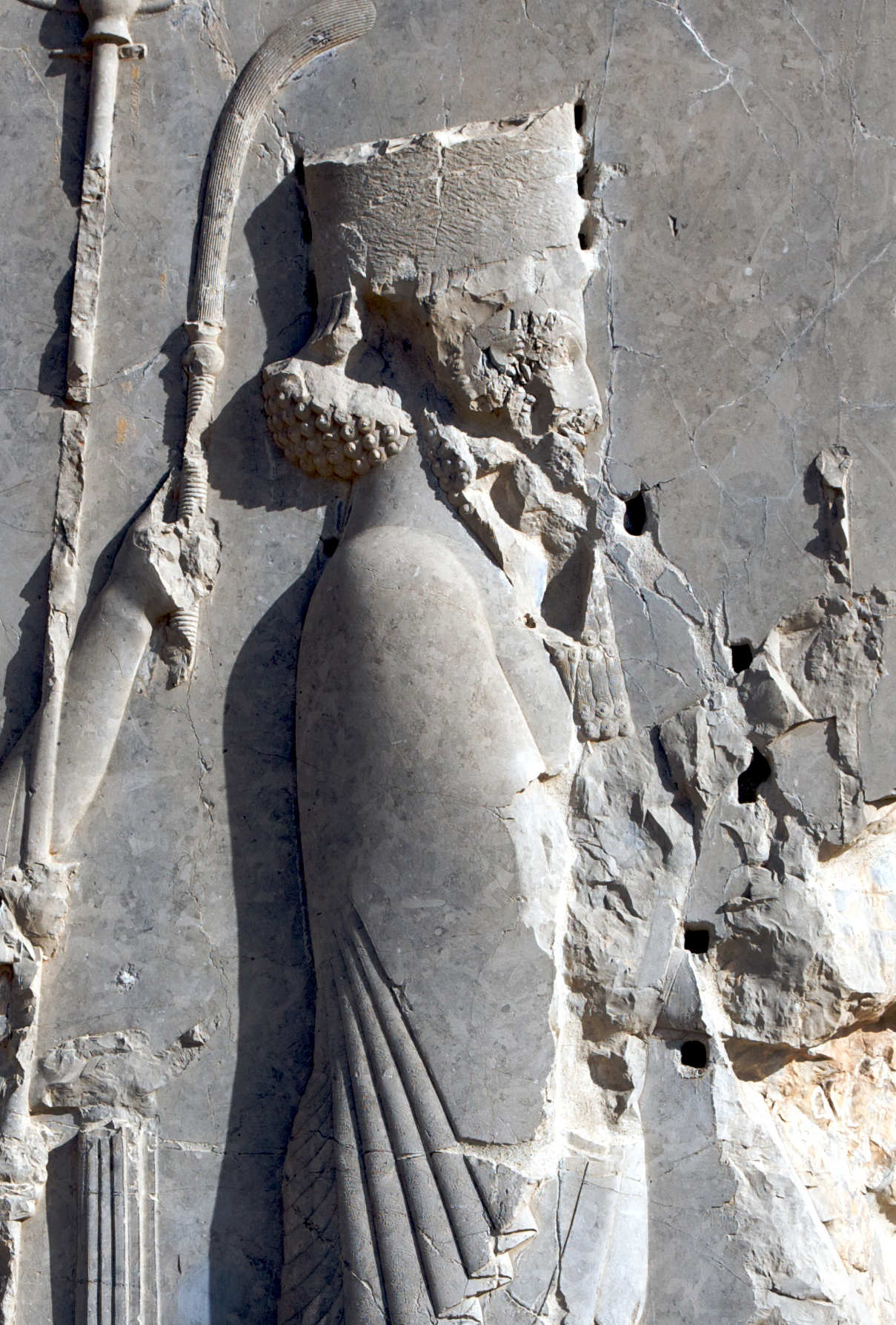
Much of what visitors see at Persepolis is Xerxes’s work. He completed the Apadana begun by his father, built the Gate of All Nations with its great bull-men, his own palace (the Hadish), the building known as the Harem, and began the Hall of a Hundred Columns, finished by his son Artaxerxes I. His inscriptions say again and again that he finished what his father began and built more besides. See Building Persepolis for how the site was put together, and our guide to the Persepolis monuments for each building.
The daiva inscription
One of the most discussed Persian texts of the reign is an inscription found at Persepolis, known as XPh or the daiva inscription. Xerxes lists the lands he ruled and then says that in one of them there was unrest, which he put down, and that in a place where daivas (false gods) had been worshipped he destroyed their sanctuary and ordered that Ahura Mazda be worshipped instead. The land is not named. Some scholars have linked it to Babylon or Egypt, others to a region in Iran, and others see the passage as a general statement of royal religious order rather than a report of a single event. It is often cited in the debate on whether the Achaemenid kings were Zoroastrians; see Religion of the Achaemenid Kings.
Court life and murder
Greek writers tell several stories about Xerxes’s household. Herodotus ends his history with a grim tale of Xerxes’s love for the wife and then the daughter of his brother Masistes, and the revenge of his queen Amestris. The story may contain court gossip, but its purpose in Herodotus is moral: the great king who failed in Greece is also unable to rule his own desires. On the women of the court, see Women of the Achaemenid Court.
In August 465 BCE Xerxes was killed in a palace plot. A Babylonian astronomical text dates the murder, and Greek writers such as Ctesias and Diodorus name a powerful courtier, Artabanus, as the killer. The accounts differ on who else was involved and on the fate of Xerxes’s eldest son Darius, who was killed in the aftermath. Another son, Artaxerxes I, took the throne.
Two very different portraits
The Greek picture of Xerxes was fixed early. In Aeschylus’s play The Persians, staged in Athens in 472 BCE, he is a proud young king brought low by the gods. Herodotus, writing later, adds the famous scenes of Xerxes having the Hellespont whipped after a storm broke his bridges, and weeping as he watched his army, because none of those men would be alive in a hundred years. Herodotus’s Xerxes is cruel and impulsive but also thoughtful at moments, a tragic figure more than a cartoon. Later Western writers, and modern films such as 300 (2006), kept only the arrogance. See Herodotus and the Persians.
In the Hebrew Bible, the king Ahasuerus of the Book of Esther is usually identified with Xerxes, since the Hebrew name matches the Persian one. The book is generally read as a story rather than a record of real events.
Xerxes’s own inscriptions present a very different king: pious, a builder, a guardian of order, and a loyal son who completed his father’s projects. Neither portrait is the whole truth. In Iran today his name lives on as the popular boy’s name Khashayar.
Persian words from this page
| خشایارشا | Khashâyârshâ | Xerxes |
| خشایار | Khashâyâr | Khashayar (modern first name) |
| شاهنشاه | shâhanshâh | King of Kings |
| بابل | Bâbel | Babylon |
| تخت جمشید | Takht-e Jamshid | Persepolis |
| کاخ | kâkh | palace |
Sources and further reading
- Herodotus, Histories, Books 7–9; Aeschylus, The Persians.
- Xerxes’s inscriptions, including XPf and XPh, translated in Amélie Kuhrt, The Persian Empire: A Corpus of Sources from the Achaemenid Period (2007).
- Amélie Kuhrt and Susan Sherwin-White, “Xerxes’ Destruction of Babylonian Temples”, in Achaemenid History II (1987).
- Pierre Briant, From Cyrus to Alexander: A History of the Persian Empire (2002).
- Encyclopaedia Iranica, “Xerxes I”.
Want to learn Persian? Get the free Starter Pack
Get the 14-page printable Starter Pack (all 32 letters, a 7-day reading plan, 100 core words and 20 survival phrases) and a short 5-email course. Free.
More in The Achaemenid Empire (550–330 BCE)
- Achaemenes, Teispes and the Early Persian Kings of Anshan
- Cyrus the Great: Birth, Legends and Rise to Power
- Cyrus Conquers Lydia: Croesus and the Battle of Thymbra
- The Persian Conquest of Ionia and Asia Minor
- Cyrus Takes Babylon (539 BCE)
- The Cyrus Cylinder
- Cyrus and the Return of the Jews
- The Death of Cyrus and the Massagetae
- Pasargadae: Cyrus’s Capital and Tomb
- The Tomb of Cyrus through History
- Cambyses II
- Cambyses Conquers Egypt: The Battle of Pelusium
- Bardiya and Gaumata: The Usurper Question
- Darius the Great Takes the Throne
- The Great Revolts of 522–521 BCE
- The Behistun Inscription
- The Persian Conquest of the Indus Valley
- Darius’s Scythian Campaign
- Darius’s Canal from the Nile to the Red Sea
- Darius’s Reforms: Satrapies, Taxes and Law
- The Royal Road and the Persian Postal System
- The Daric: Achaemenid Coinage and Economy
- The Ionian Revolt (499–493 BCE)
- The Greco-Persian Wars: An Overview
- Mardonius and the First Persian Expedition to Greece (492 BCE)
- The Battle of Marathon (490 BCE)
- The Death of Darius I and the Succession of Xerxes
- The Royal Tombs of Naqsh-e Rostam
- Xerxes I: King of Kings (486–465 BCE)
- Xerxes’ Invasion of Greece (480–479 BCE)
- The Battle of Thermopylae (480 BCE)
- The Battle of Artemisium (480 BCE)
- The Persian Capture of Athens (480–479 BCE)
- The Battle of Salamis (480 BCE)
- The Battle of Plataea and the End of the Invasion (479 BCE)
- The Palace of Darius at Susa
- Building Persepolis: How Darius and Xerxes Built Parsa
- The Persepolis Fortification and Treasury Tablets
- Herodotus and the Persians
- The Apadana Reliefs: Nations Bringing Gifts
- The Achaemenid Paradise Gardens
- The Persian Immortals and the Achaemenid Army
- The Achaemenid Navy
- Religion of the Achaemenid Kings
- Women of the Achaemenid Court
- Old Persian Language and Cuneiform
- Egypt under Persian Rule
- Babylon under Persian Rule
- Artaxerxes I
- The Peace of Callias
- Darius II and the Peloponnesian War
- Famous Satraps of the Persian Empire
- Artaxerxes II Mnemon
- Cyrus the Younger and the Battle of Cunaxa
- The King’s Peace (387 BCE)
- The Great Satraps’ Revolt
- Artaxerxes III and the Reconquest of Egypt
- Darius III, the Last Achaemenid King
- The Battle of the Granicus (334 BCE)
- The Battle of Issus (333 BCE)
- Alexander Takes Tyre, Gaza and Egypt (332 BCE)
- The Battle of Gaugamela (331 BCE)
- Ariobarzanes and the Battle of the Persian Gate
- The Burning of Persepolis (330 BCE)
- The Death of Darius III and Bessus
- The Legacy of the Achaemenid Empire