Pasargadae (پاسارگاد, Pâsârgâd) was the first capital of the Persian Empire, founded by Cyrus the Great in the 6th century BCE on the Morghab plain north-east of Shiraz. Today it is a wide, open archaeological site with Cyrus’s stone tomb, the remains of his palaces and garden, and a citadel hill, spread over about 1.6 km². This page is a practical guide to walking it; the history is told on our history pages.
| Location | Just north of the town of Madar-e Soleyman, Fars province; about 90 km north-east of Shiraz as the crow flies, and about 40 km north-east of Persepolis |
|---|---|
| Founded | By Cyrus the Great (reigned c. 559 to 530 BCE) |
| Site area | About 1.6 km², with about 3 km between the tomb and the citadel |
| UNESCO | World Heritage Site 2004; its garden is also part of “The Persian Garden” listing (2011) |
| Time needed | One to two hours; longer if you walk to every building |
| Best light | Late afternoon |

How the site is laid out
Pasargadae is not a single compact ruin like Persepolis. Cyrus built a royal park: palaces and pavilions standing apart in a landscape of gardens and water channels, with his tomb at the southern end and a fortified hill, Tall-e Takht, at the northern end. Expect long walks between buildings on open ground, with the Zagros foothills all around. The scale is part of the point: you are walking through what was once a designed garden landscape, one of the earliest known in Iran.
A paved path links the main monuments. Some visitors are driven between the tomb and the palace area; walking the whole site and back is several kilometres.
A walking route
1. The tomb of Cyrus
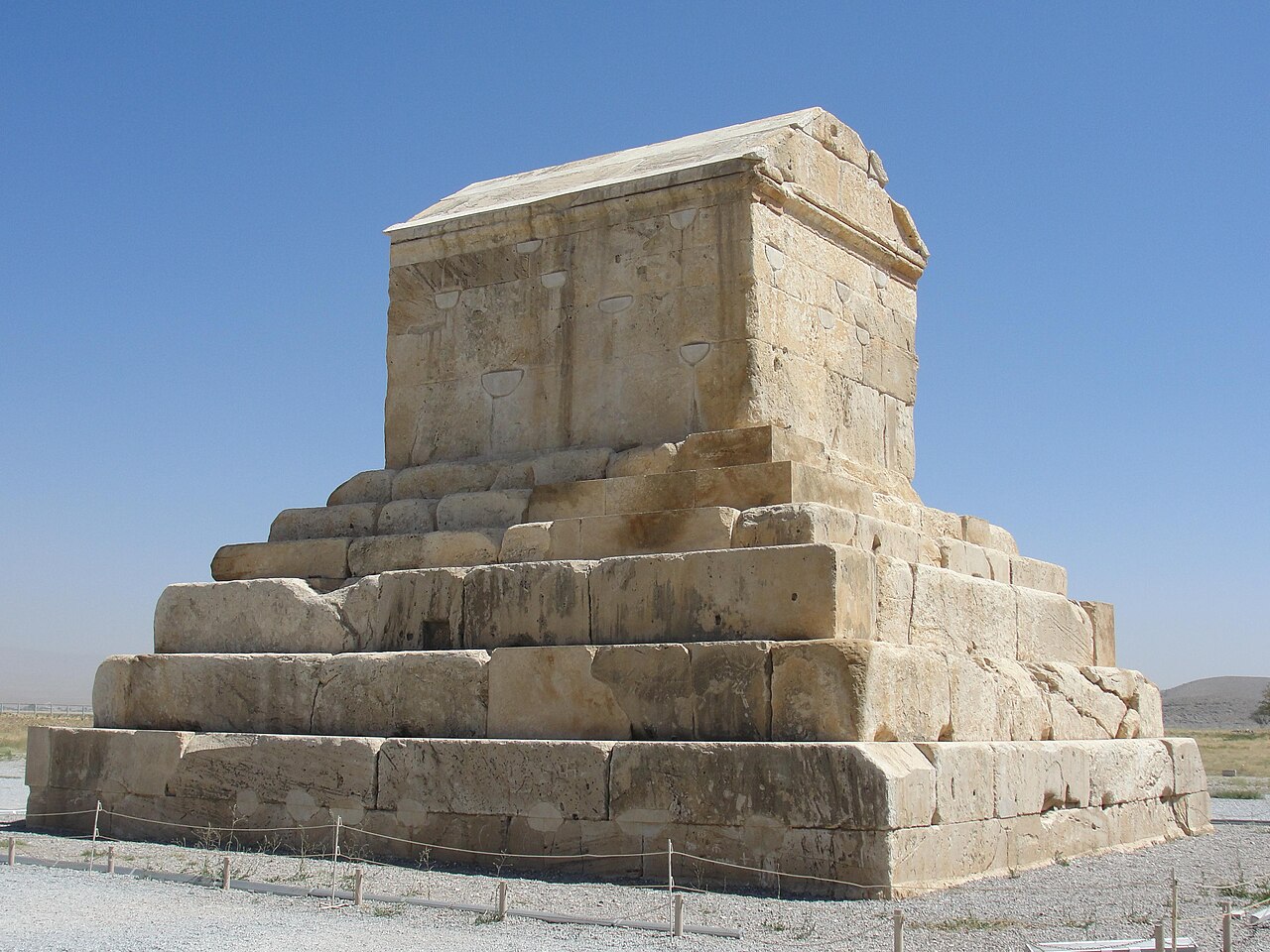
Start where everyone starts. The tomb stands alone near the entrance: a gabled stone chamber on six great steps, about 11 metres high in all. The chamber inside measures only about 3.17 by 2.11 metres, with a low, narrow doorway. Visitors cannot enter it; walk around the base to see how closely the huge limestone blocks fit, held by metal clamps without mortar. Around the tomb lie column bases and fragments from a medieval mosque that once enclosed it, a reminder that for centuries it was revered as the tomb of the mother of Solomon, مشهد مادر سلیمان, Mashhad-e Mâdar-e Soleymân. That later history, and Alexander’s visit, is told on The Tomb of Cyrus through history.
2. The gatehouse and the winged figure
Walking north, the first building in the palace area is the gatehouse, known to archaeologists as Gate R. On a surviving doorjamb is the best-known carving at Pasargadae: a four-winged figure in a long robe wearing an elaborate crown of Egyptian type. Nobody is sure whom it represents; suggestions range from a protective spirit to Cyrus himself. It is easy to walk past, so look for the shelter that protects it.
3. The audience palace
Palace S, the audience hall, still has one tall column standing and a floor of column bases. Note the contrast of black and white stone in the bases and doorways, a feature of Cyrus’s buildings, and fragments of reliefs showing feet and the lower parts of figures.
4. The residential palace and the garden
Palace P, the private palace, has short inscriptions in Old Persian, Elamite and Babylonian naming Cyrus. Between the two palaces, look on the ground for the stone channels and small basins that once carried water through a geometric garden. Archaeologists see this as an early ancestor of the four-part Persian garden; the idea and its later history are on The Persian Garden through history.
5. Zendan-e Soleyman
Further north stands the ruined stone tower called Zendan-e Soleyman, “the prison of Solomon”. Only one wall survives to full height. Its purpose is debated; it closely resembles the better-preserved Ka’ba-ye Zartosht at Naqsh-e Rostam.
6. Tall-e Takht
At the far north, a low hill carries a massive stone platform, begun under Cyrus and later turned into a fortified citadel. The masonry of the platform face is superb, and from the top you see the whole plain and the line of the site back to the tomb.
For a fuller description of each building, read our article on Pasargad; for Cyrus’s reign and why he built here, see Pasargadae: Cyrus’s capital and tomb and Cyrus the Great.
Getting there and combining sites
Pasargadae is usually visited on a day trip from Shiraz together with Persepolis and Naqsh-e Rostam; our Persepolis day-route guide suggests how to order the day. The road north passes the gorge of Tang-e Bolaghi, where an ancient route and Achaemenid-period remains were excavated in the 2000s before the Sivand dam was filled, a project that caused public concern about its effect on the region.
Coming from Yazd or Isfahan, Pasargadae lies close to the main road south to Shiraz and makes a natural stop on the way.
Practical notes
- Sun and wind. There is almost no shade. Bring a hat, water and sunscreen; in winter, wind across the plain is cold.
- Light. Late afternoon light is best for the tomb and the palace stones. Midday light is flat.
- Dates. On 29 October (7 Aban), informally marked by many Iranians as Cyrus the Great Day, crowds have gathered at the tomb in some years and access has at times been restricted around that date.
- Facilities. Facilities on site are limited; eat in Shiraz, Marvdasht or at roadside restaurants.
- Respect the monuments. Do not climb the tomb steps or the palace column bases.
- Tickets and hours. Check current official information on opening times and tickets, and follow your own government’s travel advice for Iran.
Persian words from this page
| کوروش بزرگ | Kurosh-e Bozorg | Cyrus the Great |
| آرامگاه | ârâmgâh | tomb, mausoleum |
| کاخ | kâkh | palace |
| باغ | bâgh | garden |
| زندان سلیمان | Zendân-e Soleymân | “prison of Solomon” |
| تل تخت | Tall-e Takht | “throne hill”, the citadel |
| ستون | sotun | column |
Sources and further reading
- UNESCO World Heritage Centre, “Pasargadae”, whc.unesco.org/en/list/1106.
- David Stronach, Pasargadae: A Report on the Excavations Conducted by the British Institute of Persian Studies from 1961 to 1963 (Oxford, 1978).
- Encyclopaedia Iranica, “Pasargadae” (David Stronach and Hilary Gopnik).
- Arrian, Anabasis 6.29, and Strabo, Geography 15.3.7, for the ancient descriptions of the tomb.
Want to learn Persian? Get the free Starter Pack
Get the 14-page printable Starter Pack (all 32 letters, a 7-day reading plan, 100 core words and 20 survival phrases) and a short 5-email course. Free.
More in Top Places to Visit in Iran
- Naqsh-e Jahan Square
- Shah (Imam) Mosque, Isfahan
- Sheikh Lotfollah Mosque
- Ali Qapu Palace
- Jameh Mosque of Isfahan
- Si-o-se Pol and Khaju Bridge
- Vank Cathedral
- Hasht Behesht Palace
- Naqsh-e Rostam
- Eram Garden, Shiraz
- Nasir al-Molk (Pink) Mosque
- Tomb of Hafez (Hafezieh)
- Tomb of Saadi (Saadieh)
- Shah Cheragh Shrine
- Arg of Karim Khan
- Fin Garden, Kashan
- Historic Houses of Kashan
- Jameh Mosque of Yazd
- Yazd Fire Temple and Towers of Silence
- Dowlatabad Garden and Windcatcher
- Amir Chakhmaq Complex
- Golestan Palace
- National Museum of Iran
- Treasury of National Jewels
- Tehran Grand Bazaar
- Milad Tower
- Imam Reza Shrine, Mashhad
- Tomb of Ferdowsi, Tus
- Tomb of Omar Khayyam, Neyshabur
- Tomb of Avicenna, Hamadan
- Ganjnameh Inscriptions, Hamadan
- Behistun (Bisotun): Visiting the Site
- Taq-e Bostan: Visiting the Site
- Tabriz Historic Bazaar
- Takht-e Soleyman
- Armenian Monastic Ensembles of Iran
- Sheikh Safi al-Din Shrine, Ardabil
- Dome of Soltaniyeh
- Alamut Castle
- Falak-ol-Aflak Castle
- Shushtar Historical Hydraulic System
- Chogha Zanbil: Visiting the Ziggurat
- Susa Archaeological Site
- Arg-e Bam
- Ganjali Khan Complex, Kerman
- Shazdeh Garden, Mahan
- Rayen Castle
- Dasht-e Lut (Lut Desert)
- Maranjab Desert and Caravanserai
- Varzaneh Desert
- Mount Damavand
- Hyrcanian Forests
- Lake Urmia
- Badab-e Surt Springs
- Ali Sadr Cave
- The Kaluts of Shahdad
- Qeshm Geopark
- Hormuz Island Colours
- Visiting Persepolis: A Day Trip from Shiraz
- Visiting Pasargadae
- Persian Caravanserais
- The Qanat of Gonabad
- Meymand Village
- Sasanian Sites of Fars: Firuzabad, Bishapur and Sarvestan
- Gonbad-e Qabus: Visiting the Tower
- Zayandeh Rud and Isfahan’s Bridges
- Tochal and Darband: Hiking Above Tehran
- Mount Sabalan
- Skiing in Iran: Dizin and Shemshak
- Golestan National Park