Milad Tower (برج میلاد, Borj-e Milâd) is a 435-metre concrete telecommunications tower in north-western Tehran, the tallest structure in Iran. Built between 1997 and 2007 and opened to the public in October 2008, it was meant to give the capital of the Islamic Republic a modern landmark of its own, and its observation decks are the best place to understand how large Tehran has become.
| Height | 435 m to the tip of the antenna; the roof of the pod is at about 315 m |
|---|---|
| Built | 1997–2007; inaugurated 7 October 2008 |
| Architect | Mohammad Reza Hafezi |
| Location | Between Gisha and Shahrak-e Gharb, north-west Tehran |
| Use | Broadcasting, telecommunications, tourism, conferences and events |
Our older post on Milad Tower describes its floors, restaurants and the Sky Dome in detail. This page looks at why the tower was built, how it was engineered, and how to fit a visit into a day in Tehran.

A tower from an unfinished plan
The idea of a great tower on this site is older than the tower itself. In the 1970s the Pahlavi government planned Shahestan Pahlavi, a vast new civic and commercial centre for Tehran in the Abbas Abad area, designed by the British firm Llewelyn-Davies after an international competition. The revolution of 1979 ended the project, and almost nothing of it was built.
The plan for a telecommunications tower survived in a new form. In the early 1990s the city studied 21 possible sites and chose the Gisha (Nasr) area in late 1993, on a low hill where a tall mast would carry radio and television signals across the whole basin. Construction began in 1997. It moved slowly at first: by most accounts only about 40 per cent was finished after eight years, and the rest was completed in a rush of about 30 months under the Tehran municipality.
The name came along the way. “Milad” means “birth”, and accounts of the project say it was adopted in 2001, in the run-up to the centenary of Ayatollah Khomeini’s birth. For a city whose best-known symbol was the Azadi Tower, built in 1971 for the Pahlavi monarchy’s 2,500-year celebrations, the new tower was also a statement that the Islamic Republic could build on the same scale.
How the tower is built
Milad Tower belongs to the family of concrete television towers that began with Stuttgart’s Fernsehturm in the 1950s, and it looks much like the Kuala Lumpur Tower. It has five parts:
- Foundation and base: the tower stands on an octagonal base, a nod to the eight-sided plans common in traditional Iranian architecture. The lobby block around it has six floors of shops, food courts and exhibition space.
- Shaft: a reinforced-concrete column about 315 m high, with lifts on three sides and an emergency staircase on the fourth. The lifts climb at about 7 m per second.
- Head: a 12-storey steel pod holding observation decks, restaurants including a revolving one, a gallery and technical floors.
- Antenna mast: a four-stage steel mast of about 120 m, carrying broadcast antennas.
When it was finished it was among the tallest telecommunications towers in the world, and it is still usually listed in the top ten. Rankings differ depending on what is counted, so treat any exact place in a list with care.
What to see from the top
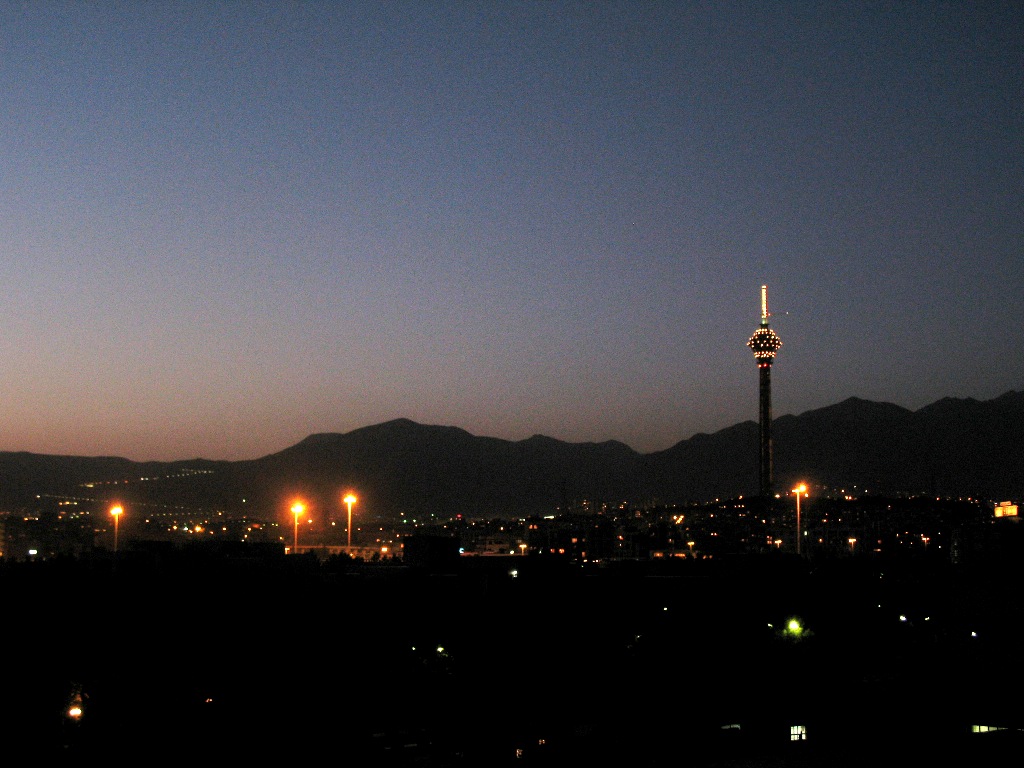
The view is the reason to go. On a clear day you can follow the line of the Alborz mountains along the north of the city, and to the north-east the cone of Mount Damavand may appear above the haze. Looking south and east, the grid of central Tehran runs towards the desert, and you can pick out the Azadi Tower to the south-west, near the old road to the airport and Karaj.
Clear air is the problem. Tehran often has smog, especially on still winter days, and the view can shrink to a few kilometres. Days after rain or strong wind are best. Sunset and the hour after are popular, because the city lights spread out to the edges of the basin.
The complex at the foot
The tower is part of a larger International Trade and Convention Center with a conference hall, a hotel and exhibition spaces. The Fajr International Film Festival, Iran’s most important film festival, has regularly been held here. The grounds and nearby parks are a common place for families to walk in the evening.
Practical notes
- Tickets: there are usually different tickets for different levels (for example the enclosed deck, the open deck and the Sky Dome). Prices and opening hours change; check current official information.
- Getting there: the tower is surrounded by motorways (Hemmat, Chamran, Hakim and Sheikh Fazlollah Nuri), so most visitors come by taxi or ride-hailing app rather than on foot.
- Timing: pick a clear day and allow two hours or more, including queues for the lifts at busy times such as holidays and Nowruz.
- Open deck: the outdoor deck can be closed in strong wind or bad weather.
- Safety: check your own government’s travel advice for Iran before planning a trip.
For the rest of the city, see our Tehran city guide and the Grand Bazaar, which shows the old Tehran that Milad Tower looks down on.
Persian words from this page
| برج | borj | tower |
| میلاد | milâd | birth |
| آسمان | âsemân | sky |
| منظره | manzareh | view |
| آسانسور | âsânsor | lift, elevator |
| بلیت | belit | ticket |
Sources and further reading
- Council on Tall Buildings and Urban Habitat, The Skyscraper Center, entry “Milad Tower”.
- World Federation of Great Towers, member entry “Milad Tower”.
- Encyclopaedia Iranica, “TEHRAN“, on the growth of the modern city.
- Ali Madanipour, Tehran: The Making of a Metropolis (Wiley, 1998), on Shahestan Pahlavi and the planning of modern Tehran.
Want to learn Persian? Get the free Starter Pack
Get the 14-page printable Starter Pack (all 32 letters, a 7-day reading plan, 100 core words and 20 survival phrases) and a short 5-email course. Free.
More in Top Places to Visit in Iran
- Naqsh-e Jahan Square
- Shah (Imam) Mosque, Isfahan
- Sheikh Lotfollah Mosque
- Ali Qapu Palace
- Jameh Mosque of Isfahan
- Si-o-se Pol and Khaju Bridge
- Vank Cathedral
- Hasht Behesht Palace
- Naqsh-e Rostam
- Eram Garden, Shiraz
- Nasir al-Molk (Pink) Mosque
- Tomb of Hafez (Hafezieh)
- Tomb of Saadi (Saadieh)
- Shah Cheragh Shrine
- Arg of Karim Khan
- Fin Garden, Kashan
- Historic Houses of Kashan
- Jameh Mosque of Yazd
- Yazd Fire Temple and Towers of Silence
- Dowlatabad Garden and Windcatcher
- Amir Chakhmaq Complex
- Golestan Palace
- National Museum of Iran
- Treasury of National Jewels
- Tehran Grand Bazaar
- Milad Tower
- Imam Reza Shrine, Mashhad
- Tomb of Ferdowsi, Tus
- Tomb of Omar Khayyam, Neyshabur
- Tomb of Avicenna, Hamadan
- Ganjnameh Inscriptions, Hamadan
- Behistun (Bisotun): Visiting the Site
- Taq-e Bostan: Visiting the Site
- Tabriz Historic Bazaar
- Takht-e Soleyman
- Armenian Monastic Ensembles of Iran
- Sheikh Safi al-Din Shrine, Ardabil
- Dome of Soltaniyeh
- Alamut Castle
- Falak-ol-Aflak Castle
- Shushtar Historical Hydraulic System
- Chogha Zanbil: Visiting the Ziggurat
- Susa Archaeological Site
- Arg-e Bam
- Ganjali Khan Complex, Kerman
- Shazdeh Garden, Mahan
- Rayen Castle
- Dasht-e Lut (Lut Desert)
- Maranjab Desert and Caravanserai
- Varzaneh Desert
- Mount Damavand
- Hyrcanian Forests
- Lake Urmia
- Badab-e Surt Springs
- Ali Sadr Cave
- The Kaluts of Shahdad
- Qeshm Geopark
- Hormuz Island Colours
- Visiting Persepolis: A Day Trip from Shiraz
- Visiting Pasargadae
- Persian Caravanserais
- The Qanat of Gonabad
- Meymand Village
- Sasanian Sites of Fars: Firuzabad, Bishapur and Sarvestan
- Gonbad-e Qabus: Visiting the Tower
- Zayandeh Rud and Isfahan’s Bridges
- Tochal and Darband: Hiking Above Tehran
- Mount Sabalan
- Skiing in Iran: Dizin and Shemshak
- Golestan National Park