The Sheikh Lotfollah Mosque (مسجد شیخ لطفالله) on the east side of Naqsh-e Jahan Square is a single domed chamber built for Shah Abbas I between 1603 and 1619. It has no courtyard and no minaret, but its cream-coloured dome and the patterned interior, lit by filtered sunlight, make it for many visitors the finest building in Isfahan.
| Persian name | Masjed-e Sheykh Lotfollâh |
|---|---|
| Dates | Inscriptions dated 1603 to 1619 |
| Builder | Mohammad Reza, son of Ostad Hosayn, of Isfahan (signed in the prayer niche) |
| Named after | Sheikh Lotfollah Meysi, a Shi’i scholar from Jabal Amil in Lebanon |
| Best time | Late morning to midday for the interior light |
The building’s place in the square and the scholar it honours are covered in The Building of Naqsh-e Jahan Square. This page is about what you see: the dome outside, the passage in, and the play of light inside.
The dome from the square
From across the square the dome looks almost pale beside the deep blue of the Shah Mosque. Its tiles have a light, buff-coloured ground, covered with a net of arabesque scrolls in blue, black and white. The colour of that ground changes with the light: creamy at midday, warmer and pinkish in the late afternoon, and almost gold just before sunset. Seeing the dome at two different times of day is part of the visit.
The dome is low and broad, and sits on a short drum pierced by windows. Unlike the Shah Mosque, it has a single shell, so the curve you see outside is close to the curve you see inside. The portal below is faced in cut-tile mosaic and muqarnas, with an inscription band designed by the court calligrapher Ali Reza Abbasi.
Why the dome is off-centre
Look at the dome and portal together from the Ali Qapu and you will see that the dome is not directly behind the entrance. As with the Shah Mosque, the square runs north to south while prayer faces south-west, towards Mecca. Here the builders turned the problem into an experience: from the portal, a low, dim corridor turns, and turns again, before releasing you into the chamber already facing the mehrâb, the prayer niche. The darkness of the corridor makes the light of the hall all the stronger when you reach it.

Inside: the dome and the light
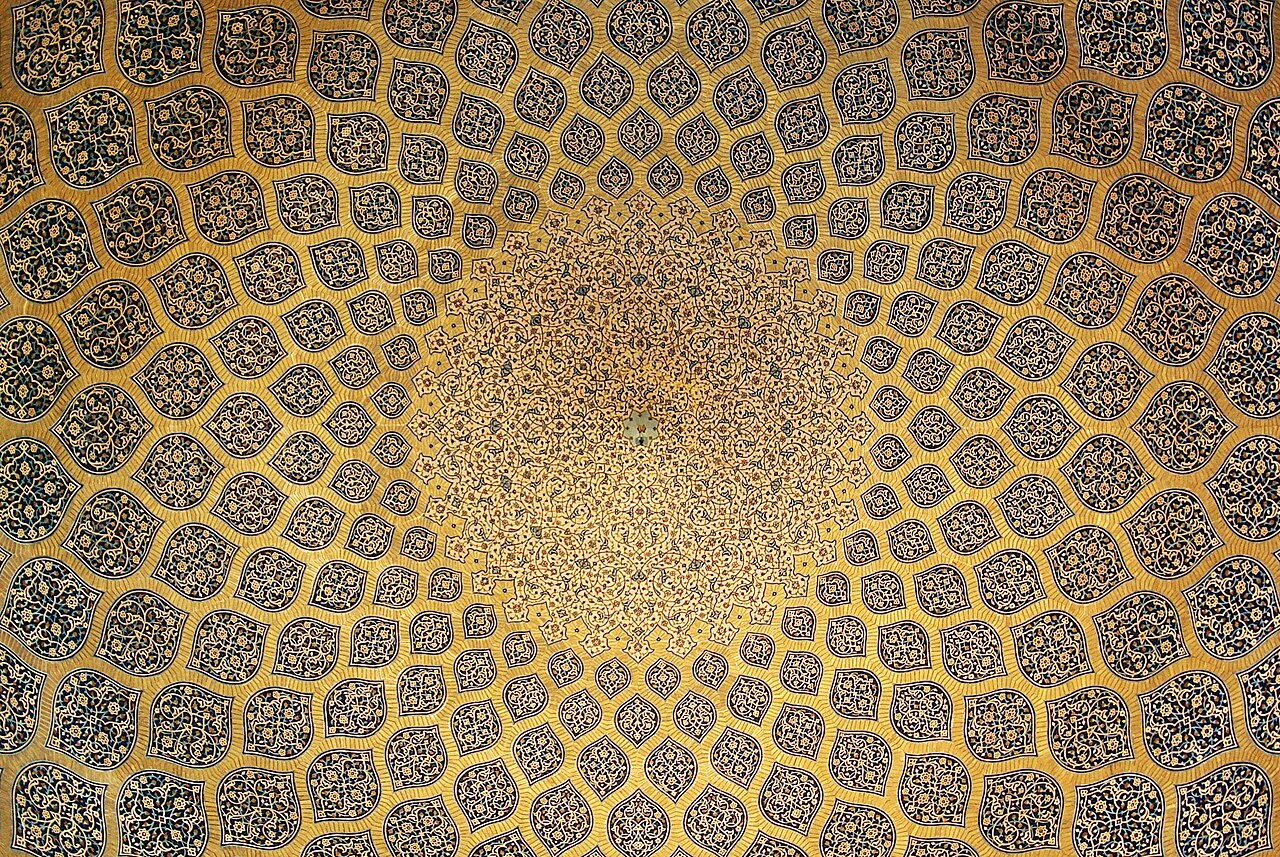
The chamber is square below and round above, with the transition made by eight large arches. Everything is covered in tile. The inner surface of the dome is a pattern of lemon-shaped medallions (toranj) in rows that grow smaller towards the top, ending in a sunburst at the centre. The effect is of a dome that seems to rise higher than it really is.
Light enters through windows in the drum fitted with double grilles of pierced tile and stone. They soften the sunlight into patches and beams that move slowly around the walls during the day. When the sun is in the right position, the beam from one window lights the base of the dome, and guides point out the “peacock”: standing at the entrance and looking up, the sunburst at the apex forms the body and the band of light the spreading tail. It is a matter of the right hour and the right spot, so ask a guard or guide where to stand.
Details on the walls
- Turquoise cable mouldings, like twisted ropes of tile, frame each arch and panel and divide the walls into clear fields.
- Long inscription bands of white script on dark blue run round the chamber at the level of the arches.
- The mehrâb, in fine mosaic tile, carries the builder’s signature, Mohammad Reza son of Ostad Hosayn. Signed work of this kind is rare and gives a name to one of the master builders of Safavid Isfahan.
Who it was for
A mosque without a courtyard or minaret was unusual. Guides often say it was built for the women of the royal household, who reached it by a tunnel from the Ali Qapu across the square. There is no evidence for the tunnel, and historians are more cautious: the building seems to have served as a royal oratory and possibly a place of teaching linked to Sheikh Lotfollah, close to the palace and separate from the great public mosque. The link to a Lebanese Shi’i scholar shows how the shah’s building was tied to his religious policy, described in Twelver Shi’ism Becomes Iran’s State Religion.
Visiting
- The interior is small, and it can feel crowded when a tour group is inside. Go early, or wait a few minutes for a group to leave: the hall is far more powerful in quiet.
- For the light inside, late morning to midday is usually best. For the colour of the dome outside, come back to the square in the late afternoon.
- Dress modestly; women should cover their hair.
- Opening hours and tickets change; check current information locally.
Early reports of the March 2026 strike near the square did not list this mosque among the damaged buildings, but check current reports and your own government’s travel advice before you go. It sits directly opposite the Ali Qapu palace, and most visitors see it on the same morning as the Shah (Imam) Mosque. For the square as a whole, see Naqsh-e Jahan Square.
Persian words from this page
| شیخ | sheykh | sheikh, religious scholar |
| گنبد | gonbad | dome |
| کاشی | kâshi | glazed tile |
| ترنج | toranj | citron; lemon-shaped medallion |
| طاووس | tâvus | peacock |
| نور | nur | light |
Sources and further reading
- UNESCO World Heritage Centre, Meidan Emam, Esfahan.
- Robert Hillenbrand, “Safavid Architecture”, in The Cambridge History of Iran, vol. 6 (1986).
- Sussan Babaie, Isfahan and Its Palaces (Edinburgh University Press, 2008).
- Robert Byron, The Road to Oxiana (1937), with a well-known description of the mosque’s interior.
Want to learn Persian? Get the free Starter Pack
Get the 14-page printable Starter Pack (all 32 letters, a 7-day reading plan, 100 core words and 20 survival phrases) and a short 5-email course. Free.
More in Top Places to Visit in Iran
- Naqsh-e Jahan Square
- Shah (Imam) Mosque, Isfahan
- Sheikh Lotfollah Mosque
- Ali Qapu Palace
- Jameh Mosque of Isfahan
- Si-o-se Pol and Khaju Bridge
- Vank Cathedral
- Hasht Behesht Palace
- Naqsh-e Rostam
- Eram Garden, Shiraz
- Nasir al-Molk (Pink) Mosque
- Tomb of Hafez (Hafezieh)
- Tomb of Saadi (Saadieh)
- Shah Cheragh Shrine
- Arg of Karim Khan
- Fin Garden, Kashan
- Historic Houses of Kashan
- Jameh Mosque of Yazd
- Yazd Fire Temple and Towers of Silence
- Dowlatabad Garden and Windcatcher
- Amir Chakhmaq Complex
- Golestan Palace
- National Museum of Iran
- Treasury of National Jewels
- Tehran Grand Bazaar
- Milad Tower
- Imam Reza Shrine, Mashhad
- Tomb of Ferdowsi, Tus
- Tomb of Omar Khayyam, Neyshabur
- Tomb of Avicenna, Hamadan
- Ganjnameh Inscriptions, Hamadan
- Behistun (Bisotun): Visiting the Site
- Taq-e Bostan: Visiting the Site
- Tabriz Historic Bazaar
- Takht-e Soleyman
- Armenian Monastic Ensembles of Iran
- Sheikh Safi al-Din Shrine, Ardabil
- Dome of Soltaniyeh
- Alamut Castle
- Falak-ol-Aflak Castle
- Shushtar Historical Hydraulic System
- Chogha Zanbil: Visiting the Ziggurat
- Susa Archaeological Site
- Arg-e Bam
- Ganjali Khan Complex, Kerman
- Shazdeh Garden, Mahan
- Rayen Castle
- Dasht-e Lut (Lut Desert)
- Maranjab Desert and Caravanserai
- Varzaneh Desert
- Mount Damavand
- Hyrcanian Forests
- Lake Urmia
- Badab-e Surt Springs
- Ali Sadr Cave
- The Kaluts of Shahdad
- Qeshm Geopark
- Hormuz Island Colours
- Visiting Persepolis: A Day Trip from Shiraz
- Visiting Pasargadae
- Persian Caravanserais
- The Qanat of Gonabad
- Meymand Village
- Sasanian Sites of Fars: Firuzabad, Bishapur and Sarvestan
- Gonbad-e Qabus: Visiting the Tower
- Zayandeh Rud and Isfahan’s Bridges
- Tochal and Darband: Hiking Above Tehran
- Mount Sabalan
- Skiing in Iran: Dizin and Shemshak
- Golestan National Park