The Shah Mosque of Isfahan, called the Imam Mosque (مسجد امام) since 1979, is the great congregational mosque that closes the south end of Naqsh-e Jahan Square. Shah Abbas I began it in 1611 and it was finished around 1630. With its blue-tiled dome, four-iwan courtyard and famous echo under the dome, it is the largest and most elaborate building of Safavid Isfahan.
| Persian names | Masjed-e Shâh, Masjed-e Emâm; also Masjed-e Jâme’-e Abbâsi |
|---|---|
| Built | 1611 to c. 1630, with some later finishing under Shah Safi |
| Patron | Shah Abbas I |
| Architect | Ostad Ali Akbar Esfahani, named in the portal inscription |
| Plan | Portal on the square, angled vestibule, four-iwan courtyard, domed sanctuary, two madrasa courts |
| UNESCO | Part of Meidan Emam, Esfahan (1979) |
When and why the mosque was built, and how it fits into Abbas’s new centre, is told in The Building of Naqsh-e Jahan Square. This page is about the building itself: how to read it as you walk through, and what to look for.

The turn behind the portal
The first thing to notice happens before you are inside. The portal faces the square squarely, on its north-south axis, but the prayer hall must face Mecca, which lies to the south-west. The builders solved this with a short vestibule behind the portal that swings you round by about 45 degrees. From the square you see the portal and the dome together; once you step through, the dome is no longer behind the portal but off to one side, and you enter the courtyard on the correct axis for prayer. Looking at the mosque from the Ali Qapu porch, you can see the whole complex sitting at an angle to the square.
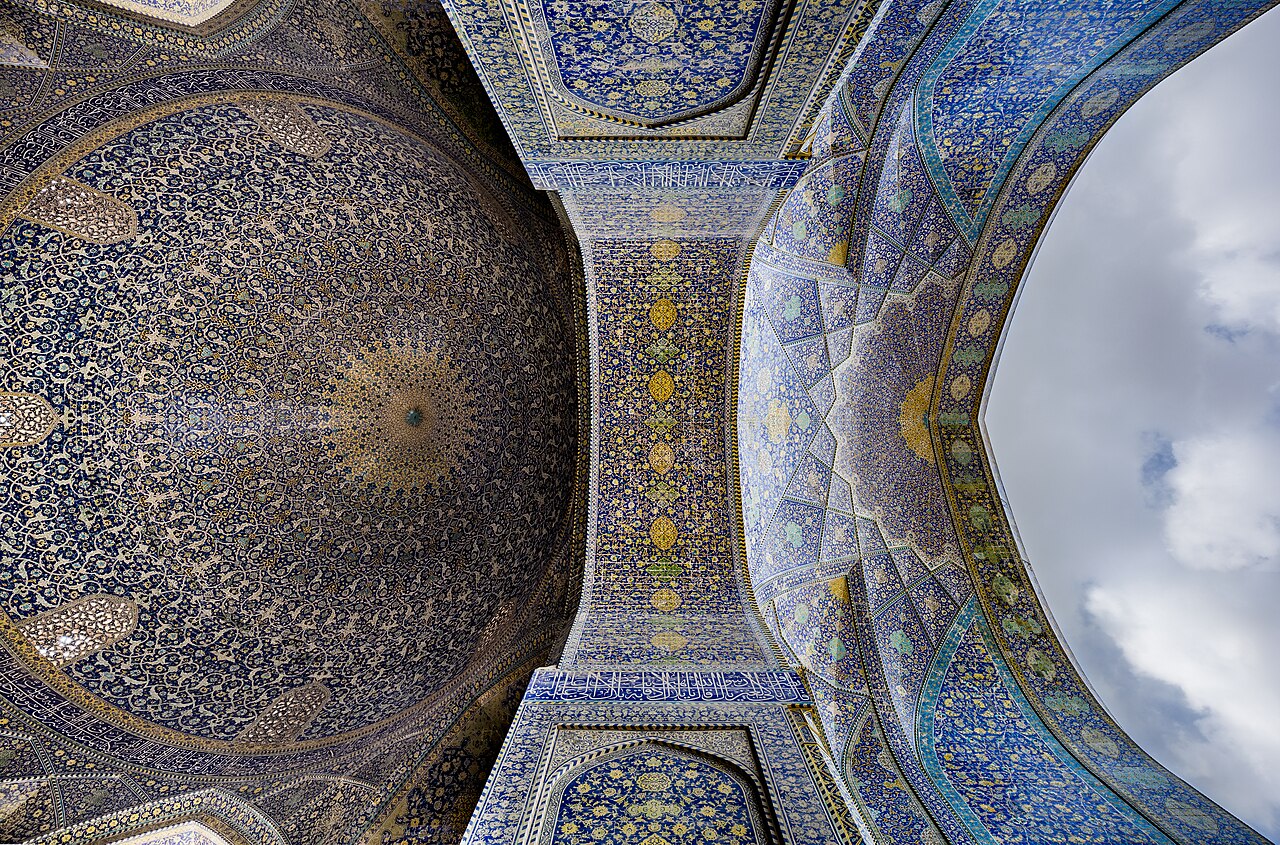
The portal itself is the most richly decorated part of the building. Its half-dome is filled with muqarnas, the stalactite-like cells of tile that step down from the top of the arch, and it is faced in cut-tile mosaic (moarraq), in which every colour is a separate piece of glazed tile cut to shape. The band of white script on blue that frames it was designed by the court calligrapher Ali Reza Abbasi and dated 1616.
Two kinds of tile
Most of the rest of the mosque is covered in a different technique, haft-rang (“seven-colour”) tiles, square tiles painted with several colours and fired together. Haft-rang was quicker and cheaper than mosaic and let the builders cover huge areas in a few years. Close up, you can see the grid of square tiles; mosaic panels, by contrast, have no grid and the colours are brighter and more jewel-like. Comparing the portal with the courtyard walls is the easiest way to learn the difference, and it explains why many historians see the mosque as a building made in a hurry by a shah who wanted to see it finished. Haft-rang also later became the standard tile of Safavid and Qajar buildings.
The courtyard and the four iwans
The courtyard is a large rectangle with a pool for ablutions in the middle. On each side is an eyvân, a tall vaulted hall open at one end. This four-iwan plan goes back to the Seljuk period and can be seen in an earlier form at the Jameh Mosque of Isfahan. Between the iwans run two storeys of arched niches.
The south iwan, the largest, is flanked by two minarets and leads into the domed sanctuary. To the left and right of the sanctuary are two smaller courtyards that served as madrasas, religious colleges, with student rooms around them. They are quieter than the main court, with trees and small pools, and are good places to sit for a while.
The dome and the echo
The sanctuary dome is a double shell: an inner dome that you see from inside and a taller outer dome, about 52 metres high, that gives the building its outline from the square. The space between the two is hollow. The outer dome is covered in turquoise and dark-blue tiles with yellow and white arabesques, and a ring of Qur’anic inscription runs round the drum.
Under the centre of the inner dome is a marked spot on the floor. If you stand on it and clap or speak, the sound comes back to you several times, sharply and clearly; step a metre away and the effect fades. Guides often demonstrate it, and visitors take turns. The echo is produced by the curved surface of the inner dome focusing sound back on its centre, and it would have helped carry the voice of a preacher. Claims that the echo repeats exactly seven times are popular but are a story rather than a measurement.
Other details to look for
- The marble dado round the lower walls of the sanctuary and the courtyard, and the marble mehrâb (prayer niche) and pulpit in the sanctuary.
- The winter prayer halls on either side of the sanctuary, with rows of low domes on piers, darker and plainer than the courtyard.
- A stone in the courtyard that is said to mark local noon by its shadow. Tradition credits its design to the scholar Sheikh Baha’i, as it credits him with many clever devices in Isfahan; there is no firm contemporary evidence for this.
Visiting
The mosque is an active place of worship. On Fridays it hosts congregational prayers at midday, and parts of it may be closed to visitors at prayer times. Dress modestly; women are asked to cover their hair, and chadors are often available at the entrance. Shoes stay on in the courtyard, but take them off where carpets are laid.
The best light is in the morning, when the sun falls on the courtyard facades and the inner surfaces of the south iwan, and tour groups are fewer. In the late afternoon the outer dome is best seen from the square or from the Ali Qapu porch. Allow at least an hour; longer if you want to sit in the madrasa courtyards.
In March 2026 Iranian officials reported that sections of the mosque’s tilework were damaged by the blast from a strike on nearby government buildings, as reported by The Art Newspaper and NPR; UNESCO said it had documented the damage at Isfahan sites. Check current information on the state of the building, and your own government’s travel advice, before you go.
The mosque is one of four buildings on the square: see our guide to Naqsh-e Jahan Square, and the Sheikh Lotfollah Mosque for a very different Safavid mosque only a few minutes’ walk away.
Persian words from this page
| مسجد | masjed | mosque |
| ایوان | eyvân | iwan, vaulted open hall |
| گنبد | gonbad | dome |
| مناره | menâre | minaret |
| محراب | mehrâb | prayer niche |
| هفترنگ | haft-rang | “seven-colour” painted tile |
| معرق | moarraq | cut-tile mosaic |
Sources and further reading
- UNESCO World Heritage Centre, Meidan Emam, Esfahan.
- Robert Hillenbrand, “Safavid Architecture”, in The Cambridge History of Iran, vol. 6 (1986).
- Sheila S. Blair and Jonathan M. Bloom, The Art and Architecture of Islam 1250–1800 (Yale University Press, 1994).
- Wilfrid Blunt, Isfahan: Pearl of Persia (1966).
- The Art Newspaper, report on damage to UNESCO sites in Isfahan, 10 March 2026.
Want to learn Persian? Get the free Starter Pack
Get the 14-page printable Starter Pack (all 32 letters, a 7-day reading plan, 100 core words and 20 survival phrases) and a short 5-email course. Free.
More in Top Places to Visit in Iran
- Naqsh-e Jahan Square
- Shah (Imam) Mosque, Isfahan
- Sheikh Lotfollah Mosque
- Ali Qapu Palace
- Jameh Mosque of Isfahan
- Si-o-se Pol and Khaju Bridge
- Vank Cathedral
- Hasht Behesht Palace
- Naqsh-e Rostam
- Eram Garden, Shiraz
- Nasir al-Molk (Pink) Mosque
- Tomb of Hafez (Hafezieh)
- Tomb of Saadi (Saadieh)
- Shah Cheragh Shrine
- Arg of Karim Khan
- Fin Garden, Kashan
- Historic Houses of Kashan
- Jameh Mosque of Yazd
- Yazd Fire Temple and Towers of Silence
- Dowlatabad Garden and Windcatcher
- Amir Chakhmaq Complex
- Golestan Palace
- National Museum of Iran
- Treasury of National Jewels
- Tehran Grand Bazaar
- Milad Tower
- Imam Reza Shrine, Mashhad
- Tomb of Ferdowsi, Tus
- Tomb of Omar Khayyam, Neyshabur
- Tomb of Avicenna, Hamadan
- Ganjnameh Inscriptions, Hamadan
- Behistun (Bisotun): Visiting the Site
- Taq-e Bostan: Visiting the Site
- Tabriz Historic Bazaar
- Takht-e Soleyman
- Armenian Monastic Ensembles of Iran
- Sheikh Safi al-Din Shrine, Ardabil
- Dome of Soltaniyeh
- Alamut Castle
- Falak-ol-Aflak Castle
- Shushtar Historical Hydraulic System
- Chogha Zanbil: Visiting the Ziggurat
- Susa Archaeological Site
- Arg-e Bam
- Ganjali Khan Complex, Kerman
- Shazdeh Garden, Mahan
- Rayen Castle
- Dasht-e Lut (Lut Desert)
- Maranjab Desert and Caravanserai
- Varzaneh Desert
- Mount Damavand
- Hyrcanian Forests
- Lake Urmia
- Badab-e Surt Springs
- Ali Sadr Cave
- The Kaluts of Shahdad
- Qeshm Geopark
- Hormuz Island Colours
- Visiting Persepolis: A Day Trip from Shiraz
- Visiting Pasargadae
- Persian Caravanserais
- The Qanat of Gonabad
- Meymand Village
- Sasanian Sites of Fars: Firuzabad, Bishapur and Sarvestan
- Gonbad-e Qabus: Visiting the Tower
- Zayandeh Rud and Isfahan’s Bridges
- Tochal and Darband: Hiking Above Tehran
- Mount Sabalan
- Skiing in Iran: Dizin and Shemshak
- Golestan National Park