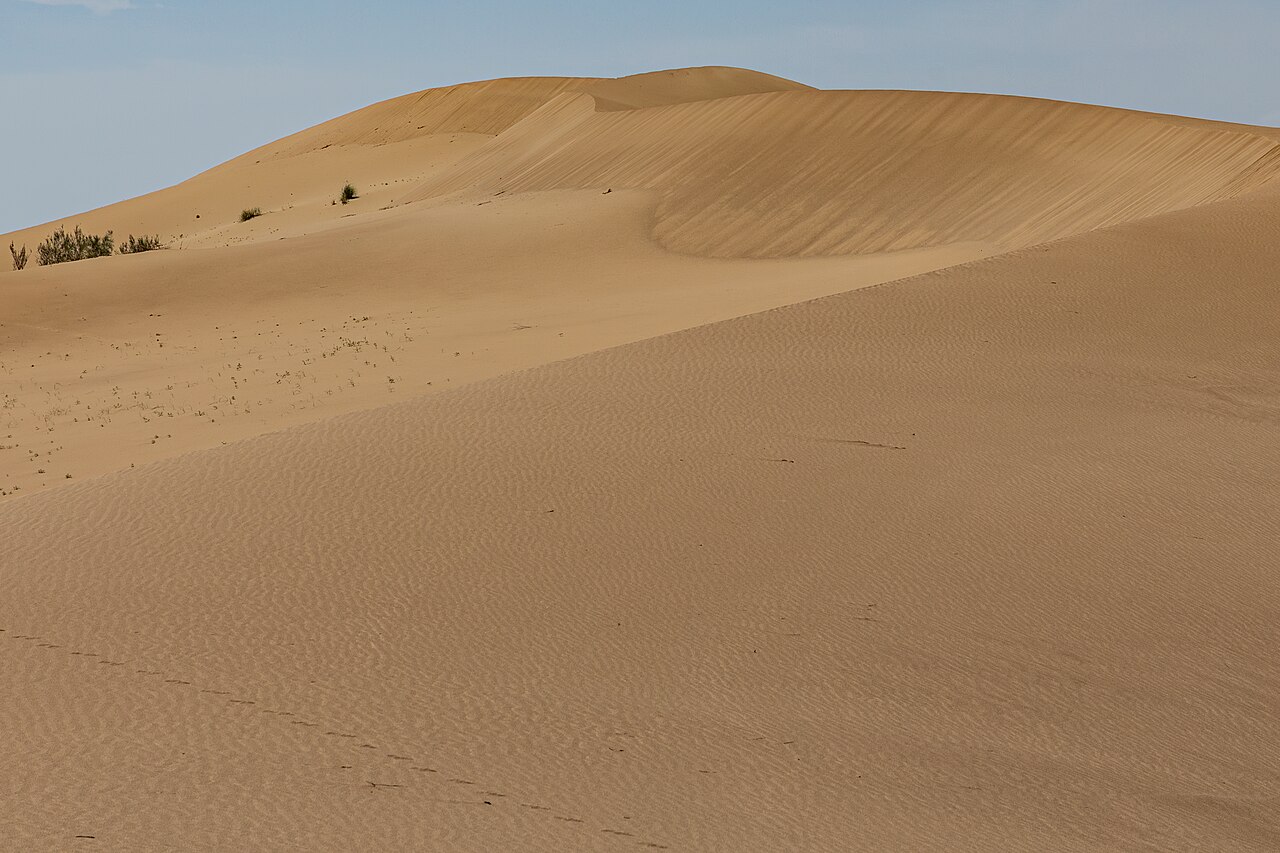
The Varzaneh Desert (کویر ورزنه) is a field of tall sand dunes just south of the small town of Varzaneh, about 105 km south-east of Isfahan. It sits beside the Gavkhouni wetland, the salt marsh where the Zayandeh Rud river ends, so in one day you can see the river’s last trickle, white salt flats and golden dunes, and then sleep in a desert town with its own customs and dialect.
| Persian name | Kavir-e Varzaneh (also Rig-e Varzaneh, the Varzaneh sands) |
|---|---|
| Location | Varzaneh county, Isfahan province, about 105 km south-east of Isfahan |
| Town altitude | About 1,477 m |
| Neighbouring wetland | Gavkhouni, Ramsar site since 1975 |
| Recognition | Varzaneh accredited as a Ramsar Wetland City in 2022 |
| Best season | October to April |

Where the Zayandeh Rud ends
Isfahan’s river, the Zayandeh Rud, rises in the Zagros mountains and flows about 300 km east. It never reaches the sea. It spreads out and evaporates in the Gavkhouni (گاوخونی) basin, a shallow salt marsh east of Varzaneh, on average about a metre deep and very salty. In wet years it is a lake with flamingos, pelicans, ducks and grebes; in dry years, and increasingly often, it shrinks to a salt crust.
The dunes formed downwind of this basin. Wind lifts fine sand and silt from the dry river plain and drops it where the air slows, building ridges that are among the most photogenic in central Iran: sharp crests, smooth faces and very few plants, unlike the scrubby dunes nearer Kashan.
Gavkhouni was listed under the Ramsar Convention in 1975. Because the wetland depends on water released upstream, and Isfahan, its farms and industry use most of the river, its condition is a direct measure of how the Zayandeh Rud is managed. The story of the river through Isfahan, and why its bed is often dry, is told on Zayandeh Rud and Isfahan’s bridges.
The town of Varzaneh
Varzaneh (ورزنه) is a farming town of roughly 13,000 people (2016 census). It is worth an hour or two before you head for the sand.
- The white chador. Many women in Varzaneh wear a white chador rather than the black one usual in most Iranian towns. It is the most famous local custom and the subject of many photographs; ask before photographing anyone.
- The Friday mosque. The old Jameh Mosque has a tall tiled portal and minaret from the Timurid period, and is the town’s main historic monument.
- Pigeon towers. Round mud-brick towers in the fields once housed thousands of pigeons, whose droppings were collected as fertiliser for melons and other crops.
- Dialect and food. People speak a local dialect alongside Persian, and the guesthouses in old courtyard houses serve home cooking.
In 2022 Varzaneh became the first Iranian town accredited as a Wetland City under the Ramsar Convention, recognising local work to protect Gavkhouni.
What to see in the desert
The dunes
The main dune field begins a short drive south of the town. Climb the first big ridge in late afternoon, when the light picks out the ripples, and stay for sunset. The sand is fine; walking along crests is far easier than straight up a slip face.
Salt flats and the salt works
Between town and wetland are salt pans where salt is scraped and piled. After rain, water lying on the flats makes a mirror, and dry periods leave hexagonal crust patterns.
Gavkhouni
If water is present, birdwatching at the wetland’s edge is best early in the morning. Keep a distance from flocks; disturbance makes birds abandon feeding areas.
Night
Many visitors camp or stay late for the stars. On clear winter nights the Milky Way is easy to see once the town lights are behind a dune.
Activities, and their cost to the desert
Varzaneh has become a weekend playground: camel rides, sandboarding, and quad bikes and 4x4s racing over the dunes. The motorised part is controversial. Engines are loud, tyre tracks break up crusts that hold sand in place, and fuel and litter end up in the sand. If you want the desert at its best, choose walking or camels, go on a weekday, and pick an operator who keeps vehicles to set tracks.
Practical notes and safety
- Come between October and April. Summer heat is extreme, and winter nights can be close to or below freezing.
- Most people arrive from Isfahan by car or on a tour; local guesthouses in Varzaneh arrange dune trips.
- Do not drive onto the sand or salt in an ordinary car. Soft sand and wet salt crust trap vehicles, and help may be far away.
- Carry water, a hat and sunglasses; sand glare is strong. Keep phones and cameras in a bag when the wind rises.
- Dress modestly in town, as elsewhere in Iran, and check current access and local arrangements. Follow your own government’s travel advice for Iran.
Varzaneh is an easy add-on to a stay in Isfahan. For a desert closer to Kashan with a historic caravanserai, see Maranjab; for the hottest and strangest desert landscapes, see the Kaluts of Shahdad.
Persian words from this page
| ریگ | rig | sand, sand dunes |
| تالاب | tâlâb | wetland |
| چادر سفید | châdor-e sefid | white chador |
| کبوترخانه | kabutar-khâne | pigeon tower |
| زاینده رود | Zâyande Rud | Zayandeh river |
| شتر | shotor | camel |
Sources and further reading
- Ramsar Sites Information Service, “Gavkhouni Lake and marshes of the lower Zayandeh Rud”, Ramsar site listed 1975.
- Ramsar Convention Secretariat, Wetland City Accreditation, 2022 cycle (COP14).
- Statistical Centre of Iran, National Census 2016, Varzaneh city.
- “Gavkhouni” and “Varzaneh”, Wikipedia, consulted 2026, as pointers to the sources above.
Want to learn Persian? Get the free Starter Pack
Get the 14-page printable Starter Pack (all 32 letters, a 7-day reading plan, 100 core words and 20 survival phrases) and a short 5-email course. Free.
More in Top Places to Visit in Iran
- Naqsh-e Jahan Square
- Shah (Imam) Mosque, Isfahan
- Sheikh Lotfollah Mosque
- Ali Qapu Palace
- Jameh Mosque of Isfahan
- Si-o-se Pol and Khaju Bridge
- Vank Cathedral
- Hasht Behesht Palace
- Naqsh-e Rostam
- Eram Garden, Shiraz
- Nasir al-Molk (Pink) Mosque
- Tomb of Hafez (Hafezieh)
- Tomb of Saadi (Saadieh)
- Shah Cheragh Shrine
- Arg of Karim Khan
- Fin Garden, Kashan
- Historic Houses of Kashan
- Jameh Mosque of Yazd
- Yazd Fire Temple and Towers of Silence
- Dowlatabad Garden and Windcatcher
- Amir Chakhmaq Complex
- Golestan Palace
- National Museum of Iran
- Treasury of National Jewels
- Tehran Grand Bazaar
- Milad Tower
- Imam Reza Shrine, Mashhad
- Tomb of Ferdowsi, Tus
- Tomb of Omar Khayyam, Neyshabur
- Tomb of Avicenna, Hamadan
- Ganjnameh Inscriptions, Hamadan
- Behistun (Bisotun): Visiting the Site
- Taq-e Bostan: Visiting the Site
- Tabriz Historic Bazaar
- Takht-e Soleyman
- Armenian Monastic Ensembles of Iran
- Sheikh Safi al-Din Shrine, Ardabil
- Dome of Soltaniyeh
- Alamut Castle
- Falak-ol-Aflak Castle
- Shushtar Historical Hydraulic System
- Chogha Zanbil: Visiting the Ziggurat
- Susa Archaeological Site
- Arg-e Bam
- Ganjali Khan Complex, Kerman
- Shazdeh Garden, Mahan
- Rayen Castle
- Dasht-e Lut (Lut Desert)
- Maranjab Desert and Caravanserai
- Varzaneh Desert
- Mount Damavand
- Hyrcanian Forests
- Lake Urmia
- Badab-e Surt Springs
- Ali Sadr Cave
- The Kaluts of Shahdad
- Qeshm Geopark
- Hormuz Island Colours
- Visiting Persepolis: A Day Trip from Shiraz
- Visiting Pasargadae
- Persian Caravanserais
- The Qanat of Gonabad
- Meymand Village
- Sasanian Sites of Fars: Firuzabad, Bishapur and Sarvestan
- Gonbad-e Qabus: Visiting the Tower
- Zayandeh Rud and Isfahan’s Bridges
- Tochal and Darband: Hiking Above Tehran
- Mount Sabalan
- Skiing in Iran: Dizin and Shemshak
- Golestan National Park