The Ganjali Khan Complex is a Safavid civic centre in the old heart of Kerman, built in the years around 1600 by Ganj Ali Khan, governor of Kerman for Shah Abbas I from 1596 to 1621. Around a rectangular square it groups a bathhouse, a caravanserai, a mint, a mosque, a school, a water cistern and a bazaar, and its bathhouse, with painted ceilings and costumed figures, is one of the best museums of its kind in Iran.
| Persian name | مجموعه گنجعلیخان (Majmu’e-ye Ganj’ali Khân) |
|---|---|
| Founder | Ganj Ali Khan, Kurdish commander and governor of Kerman (1596–1621) |
| Architect | Mohammad Soltani of Yazd |
| Dated buildings | Caravanserai portal 1598; bathhouse 1611 |
| Size | About 11,000 square metres; the square is about 99 by 54 metres |
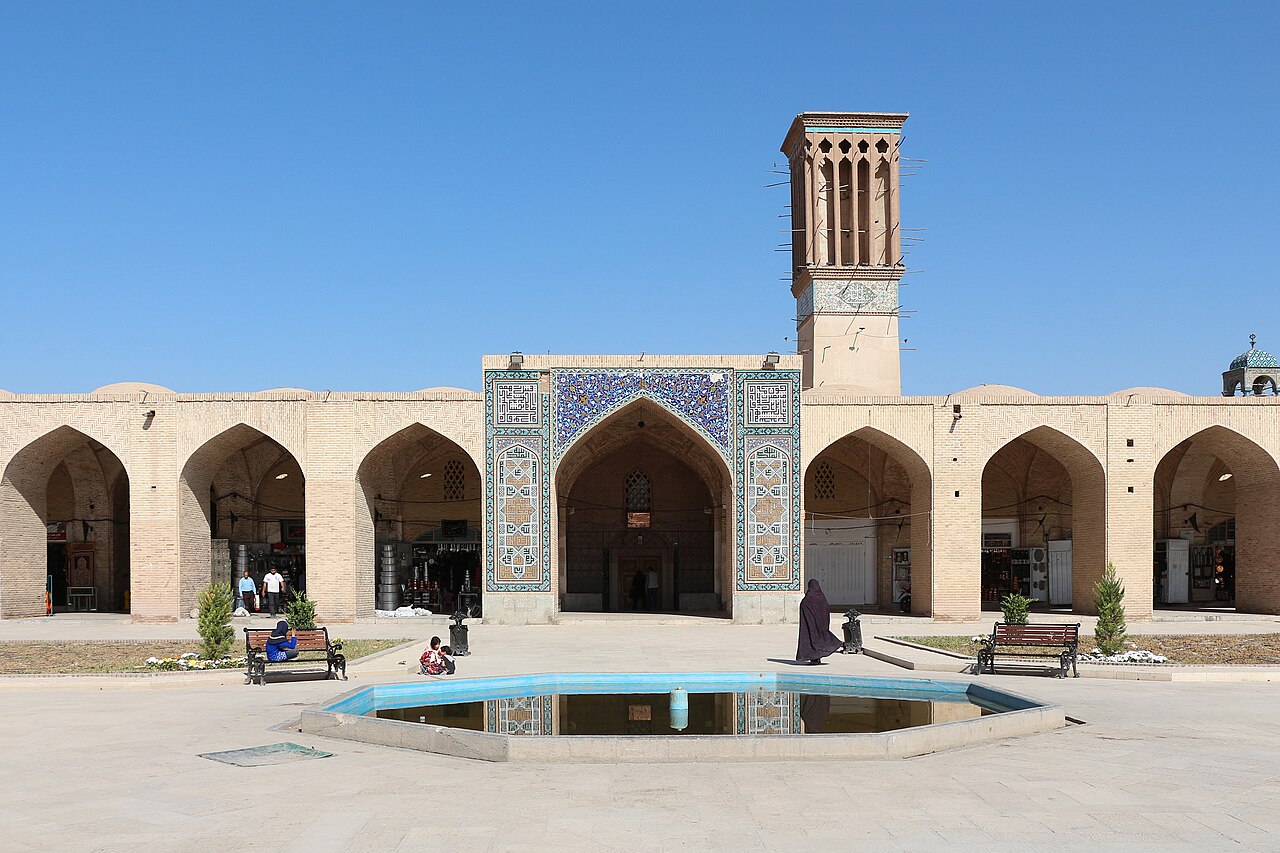

A governor’s showpiece
Ganj Ali Khan was one of the Kurdish officers who rose with Shah Abbas I, and he governed Kerman, and later also Sistan and Kandahar, for a quarter of a century. Like the shah in Isfahan, he used a new square to give the city a new centre, with trade, worship, bathing and government around one open space. Inscriptions on the buildings date the work, and one of them, on the caravanserai portal, names the calligrapher Alireza Abbasi, who also designed inscriptions for the shah’s buildings in Isfahan. The square was planned along the main bazaar of the city, so the complex was a working part of Kerman’s economy rather than a palace set apart. The wider story of the city is on our page on Kerman.
The bathhouse
The Ganjali Khan bathhouse (حمام گنجعلیخان), entered from the bazaar on the south side of the square, is the highlight. Built in 1611, it served the city as a public bath for centuries and was turned into an anthropology museum in 1971.
You go down a passage into the sarbineh, the domed changing hall, where bathers undressed, rested and talked on raised platforms around a central pool. The vaults and walls are covered with painted plaster, tile and carved stone, with Safavid painted decoration around the entrance. Life-size figures, made at the Faculty of Fine Arts of Tehran University in 1973, show the bath in use: bath attendants, barbers and bathers at rest. The figures are a little theatrical, but they bring the rooms to life. Beyond is the hot room, the garmkhaneh, with its own pools and alcoves. Look up at the light openings in the domes, and down: the patterns of the stone floors were designed to echo the vaults above.
Around the square
The caravanserai
On the east side of the square is the caravanserai, with a tiled portal bearing the foundation inscription of 1598. Inside is a classic four-iwan courtyard with two storeys of rooms and an octagonal pool in the centre.
The mint and coin museum
The former mint (ضرابخانه), a domed building with a cupola that let in light and let out the heat of the furnaces, became a coin museum in 1970. It shows coins of many periods, from the Parthians and Sasanians to the Safavids and Afsharids.
The mosque, the cistern and the bazaar
Beside the caravanserai on the east side is a small mosque with fine tile and stone work, one of the most refined buildings of the complex. The water cistern (ab-anbar) stored drinking water for the quarter. Along the south side, the stretch of bazaar called the Ganjali Khan Bazaar runs for about 93 metres, with painted and plastered vaults and openings onto the square. It continues as part of Kerman’s long covered bazaar, which links the old city from end to end; walking it is the best way to reach the complex.
Practical notes
- The complex is in the old city centre, in the middle of the bazaar, and easy to combine with Kerman’s Jameh Mosque and the rest of the bazaar.
- Allow at least an hour for the bathhouse alone. Separate entrances and tickets may apply to the bathhouse and coin museum; check current opening hours locally.
- From Kerman, day trips run to Shazdeh Garden in Mahan, Rayen Castle and the Kaluts of Shahdad.
Persian words from this page
| میدان | meydân | square |
| حمام | hammâm | bathhouse |
| سربینه | sarbine | changing hall of a bath |
| گرمخانه | garmkhâne | hot room |
| کاروانسرا | kârvânsarâ | caravanserai |
| آبانبار | âb-anbâr | water cistern |
Sources and further reading
- Encyclopaedia Iranica, “Ganj-ʿAlī Khan”.
- Encyclopaedia Iranica, “Kerman” (monuments of the city).
- Robert Hillenbrand, Islamic Architecture: Form, Function and Meaning (Edinburgh, 1994), on Safavid bathhouses and caravanserais.
- Sheila S. Blair and Jonathan M. Bloom, The Art and Architecture of Islam 1250–1800 (Yale, 1994).
Want to learn Persian? Get the free Starter Pack
Get the 14-page printable Starter Pack (all 32 letters, a 7-day reading plan, 100 core words and 20 survival phrases) and a short 5-email course. Free.
More in Top Places to Visit in Iran
- Naqsh-e Jahan Square
- Shah (Imam) Mosque, Isfahan
- Sheikh Lotfollah Mosque
- Ali Qapu Palace
- Jameh Mosque of Isfahan
- Si-o-se Pol and Khaju Bridge
- Vank Cathedral
- Hasht Behesht Palace
- Naqsh-e Rostam
- Eram Garden, Shiraz
- Nasir al-Molk (Pink) Mosque
- Tomb of Hafez (Hafezieh)
- Tomb of Saadi (Saadieh)
- Shah Cheragh Shrine
- Arg of Karim Khan
- Fin Garden, Kashan
- Historic Houses of Kashan
- Jameh Mosque of Yazd
- Yazd Fire Temple and Towers of Silence
- Dowlatabad Garden and Windcatcher
- Amir Chakhmaq Complex
- Golestan Palace
- National Museum of Iran
- Treasury of National Jewels
- Tehran Grand Bazaar
- Milad Tower
- Imam Reza Shrine, Mashhad
- Tomb of Ferdowsi, Tus
- Tomb of Omar Khayyam, Neyshabur
- Tomb of Avicenna, Hamadan
- Ganjnameh Inscriptions, Hamadan
- Behistun (Bisotun): Visiting the Site
- Taq-e Bostan: Visiting the Site
- Tabriz Historic Bazaar
- Takht-e Soleyman
- Armenian Monastic Ensembles of Iran
- Sheikh Safi al-Din Shrine, Ardabil
- Dome of Soltaniyeh
- Alamut Castle
- Falak-ol-Aflak Castle
- Shushtar Historical Hydraulic System
- Chogha Zanbil: Visiting the Ziggurat
- Susa Archaeological Site
- Arg-e Bam
- Ganjali Khan Complex, Kerman
- Shazdeh Garden, Mahan
- Rayen Castle
- Dasht-e Lut (Lut Desert)
- Maranjab Desert and Caravanserai
- Varzaneh Desert
- Mount Damavand
- Hyrcanian Forests
- Lake Urmia
- Badab-e Surt Springs
- Ali Sadr Cave
- The Kaluts of Shahdad
- Qeshm Geopark
- Hormuz Island Colours
- Visiting Persepolis: A Day Trip from Shiraz
- Visiting Pasargadae
- Persian Caravanserais
- The Qanat of Gonabad
- Meymand Village
- Sasanian Sites of Fars: Firuzabad, Bishapur and Sarvestan
- Gonbad-e Qabus: Visiting the Tower
- Zayandeh Rud and Isfahan’s Bridges
- Tochal and Darband: Hiking Above Tehran
- Mount Sabalan
- Skiing in Iran: Dizin and Shemshak
- Golestan National Park