The Treasury of National Jewels (خزانه جواهرات ملی) is the museum in the vaults of the Central Bank of Iran in Tehran where the former crown jewels of Iran are displayed. Gathered mainly from the Safavid period onwards and greatly enlarged by Nader Shah’s plunder of Delhi in 1739, the collection includes the Darya-ye Noor, the largest known pink diamond, the Qajar and Pahlavi crowns, a jewelled globe and the throne known as the Peacock Throne.
| Persian name | Khazâne-ye Javâherât-e Melli |
|---|---|
| Location | Central Bank of Iran (Bânk-e Markazi), Ferdowsi Avenue, central Tehran |
| Collection | Crowns, tiaras, aigrettes, jewelled arms, thrones, unset stones and vessels, 16th–20th centuries |
| Owner | The state, since a law of 1937; held as part of the reserves backing the currency |
| Best-known pieces | Darya-ye Noor diamond, Kiani Crown, Pahlavi Crown, Globe of Jewels, Sun (Peacock) Throne, Noor-ol-Ain tiara |
How the collection was formed
The Safavid shahs built up a large royal treasury in the 16th and 17th centuries. Much of it was lost when Afghan invaders took Isfahan in 1722. The man who restored Iranian power, Nader Shah, more than made up for it. In 1739 he defeated the Mughal emperor at Karnal and occupied Delhi, and he carried home the Mughal treasury, including the famous Peacock Throne of Shah Jahan and the diamonds Koh-i-Noor and Darya-ye Noor. Our page on the Battle of Karnal and the sack of Delhi tells that story.
After Nader was murdered in 1747, much of the treasure was scattered. The Koh-i-Noor went east with his Afghan commander Ahmad Shah Durrani and, after passing through the hands of the Sikh rulers of Punjab, ended up with the British crown. The Mughal Peacock Throne was broken up and lost. The Darya-ye Noor passed to Nader’s grandson, then to the Zands, and finally to the Qajars, who kept and added to the treasury in Tehran.
In 1937, under Reza Shah, ownership of the jewels passed from the crown to the state. They were placed in the vaults of Bank Melli and used as part of the reserve backing Iran’s currency, a role they later kept at the Central Bank. That economic role is one reason they survived the end of the monarchy in 1979. Mohammad Reza Shah opened a selection to the public in the 1960s, and after a period of closure following the revolution the treasury was reopened to visitors.
The main pieces
The Darya-ye Noor
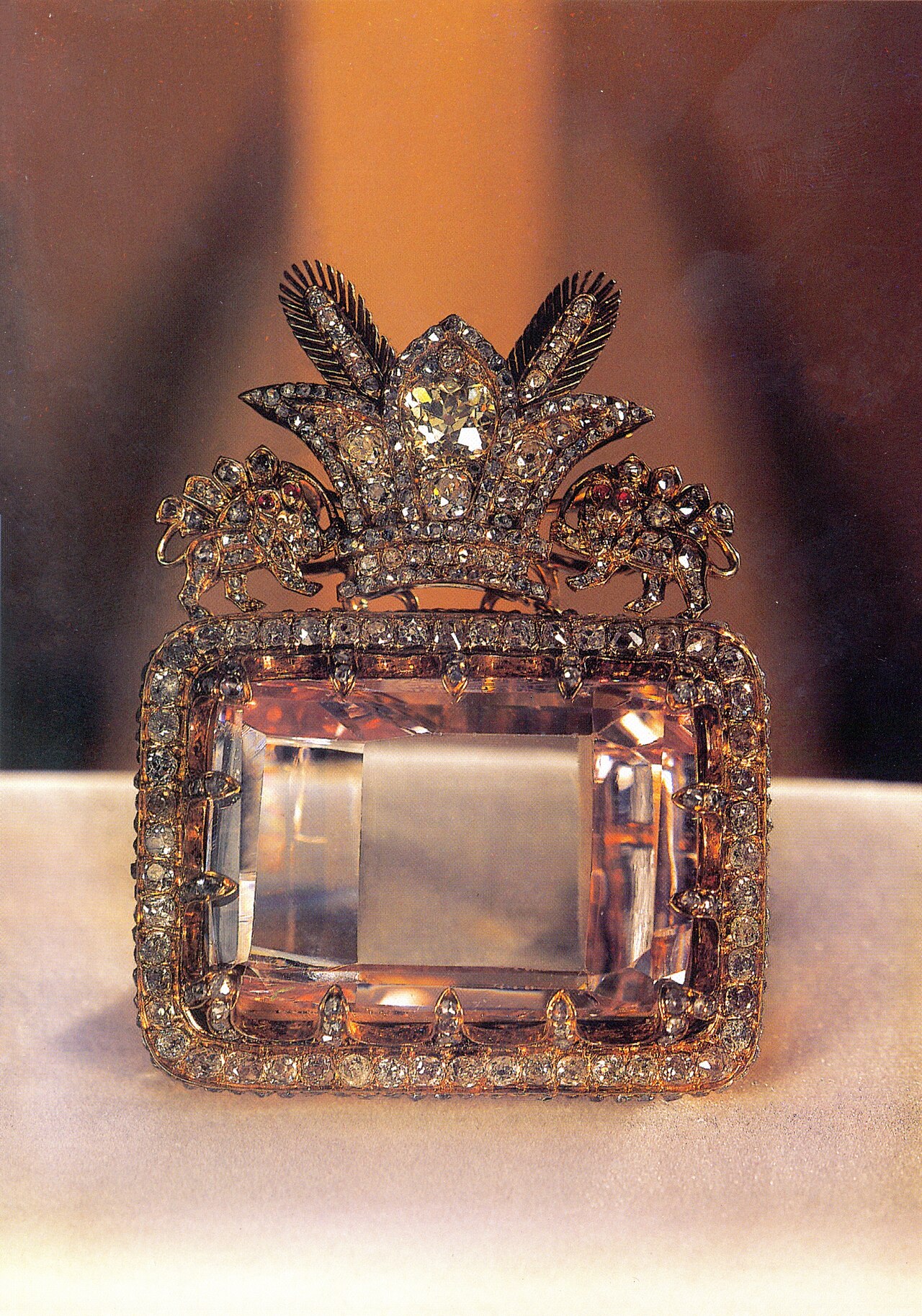
The Darya-ye Noor (دریای نور, “Sea of Light”) is a pale pink diamond of about 182 carats, flat and table-cut. It is believed to come from the Golconda mines of southern India, like the Koh-i-Noor. A Canadian team that studied the jewels in the 1960s suggested that it and the Noor-ol-Ain were cut from a single huge pink stone, the “Great Table” that the French jeweller Jean-Baptiste Tavernier described seeing in India in 1642. The idea is plausible but not proven. Naser al-Din Shah had it set in a frame of 457 smaller diamonds and four rubies, topped with the lion-and-sun emblem.

Crowns
The Kiani Crown, made for Fath-Ali Shah Qajar, is a tall red-velvet crown covered in pearls, spinels, emeralds and diamonds, the crown seen in so many Qajar portraits. The Pahlavi Crown was made for Reza Shah’s coronation in 1926 by Iranian jewellers, using stones from the treasury, and was worn again by Mohammad Reza Shah in 1967.
The Globe of Jewels
Made in 1869 for Naser al-Din Shah, the globe is a sphere of gold set with tens of thousands of stones, around 51,000 according to the figures usually cited by the treasury. The seas are emeralds and the land is picked out in rubies, spinels and diamonds. It is said to have been made partly to keep loose stones together in one place.
The “Peacock Throne”
The platform throne in the collection is often called the Peacock Throne, but it is not the Mughal throne Nader took from Delhi. It was made for Fath-Ali Shah in the early 19th century and is properly called the Sun Throne (Takht-e Khorshid), after the jewelled sun on its back. The usual explanation for the other name is that Fath-Ali Shah married a favourite wife, Tavus Khanum (tâvus means “peacock”), on it. It stood in Golestan Palace until 1980, when it was moved to the treasury. The Naderi Throne, a chair-shaped throne also in the collection, is a later Qajar piece despite its name.
The Noor-ol-Ain tiara
The Noor-ol-Ain, a pink diamond of about 60 carats, is set in a tiara made by the New York firm Harry Winston for the wedding of Mohammad Reza Shah and Farah Diba in 1959.
What the jewels are worth
There is no published valuation that can be trusted. Figures circulating online are guesses. Many of the stones are old-cut, flawed or historically significant in ways that make a market price hard to define. It is safer to say simply that the collection is one of the largest and most historically important jewel collections in the world.
Visiting
- The treasury is inside a working central bank, so security is strict. Bags, phones and cameras have usually had to be left at the entrance, and photography inside is not allowed.
- Opening has traditionally been limited to a few days a week and short hours, and it can close without much notice. Check current official information before you go, and see your own government’s travel advice for Iran.
- Combine a visit with the Golestan Palace, where the shahs once used many of these pieces, and the National Museum. Our Tehran page has the wider city.
Persian words from this page
| جواهرات | javâherât | jewels |
| الماس | almâs | diamond |
| دریای نور | Daryâ-ye Nur | “Sea of Light” |
| تاج | tâj | crown |
| تخت طاووس | Takht-e Tâvus | the Peacock Throne |
| خورشید | khorshid | sun |
| بانک مرکزی | Bânk-e Markazi | Central Bank |
Sources and further reading
- Encyclopaedia Iranica, “CROWN JEWELS of Persia“.
- Encyclopaedia Iranica, “DARYĀ-YE NŪR“.
- V. B. Meen and A. D. Tushingham, Crown Jewels of Iran (University of Toronto Press, 1968).
- Jean-Baptiste Tavernier, Travels in India (first published 1676), on the Great Table diamond.
- William Dalrymple and Anita Anand, Koh-i-Noor: The History of the World’s Most Infamous Diamond (Bloomsbury, 2017).
Want to learn Persian? Get the free Starter Pack
Get the 14-page printable Starter Pack (all 32 letters, a 7-day reading plan, 100 core words and 20 survival phrases) and a short 5-email course. Free.
More in Top Places to Visit in Iran
- Naqsh-e Jahan Square
- Shah (Imam) Mosque, Isfahan
- Sheikh Lotfollah Mosque
- Ali Qapu Palace
- Jameh Mosque of Isfahan
- Si-o-se Pol and Khaju Bridge
- Vank Cathedral
- Hasht Behesht Palace
- Naqsh-e Rostam
- Eram Garden, Shiraz
- Nasir al-Molk (Pink) Mosque
- Tomb of Hafez (Hafezieh)
- Tomb of Saadi (Saadieh)
- Shah Cheragh Shrine
- Arg of Karim Khan
- Fin Garden, Kashan
- Historic Houses of Kashan
- Jameh Mosque of Yazd
- Yazd Fire Temple and Towers of Silence
- Dowlatabad Garden and Windcatcher
- Amir Chakhmaq Complex
- Golestan Palace
- National Museum of Iran
- Treasury of National Jewels
- Tehran Grand Bazaar
- Milad Tower
- Imam Reza Shrine, Mashhad
- Tomb of Ferdowsi, Tus
- Tomb of Omar Khayyam, Neyshabur
- Tomb of Avicenna, Hamadan
- Ganjnameh Inscriptions, Hamadan
- Behistun (Bisotun): Visiting the Site
- Taq-e Bostan: Visiting the Site
- Tabriz Historic Bazaar
- Takht-e Soleyman
- Armenian Monastic Ensembles of Iran
- Sheikh Safi al-Din Shrine, Ardabil
- Dome of Soltaniyeh
- Alamut Castle
- Falak-ol-Aflak Castle
- Shushtar Historical Hydraulic System
- Chogha Zanbil: Visiting the Ziggurat
- Susa Archaeological Site
- Arg-e Bam
- Ganjali Khan Complex, Kerman
- Shazdeh Garden, Mahan
- Rayen Castle
- Dasht-e Lut (Lut Desert)
- Maranjab Desert and Caravanserai
- Varzaneh Desert
- Mount Damavand
- Hyrcanian Forests
- Lake Urmia
- Badab-e Surt Springs
- Ali Sadr Cave
- The Kaluts of Shahdad
- Qeshm Geopark
- Hormuz Island Colours
- Visiting Persepolis: A Day Trip from Shiraz
- Visiting Pasargadae
- Persian Caravanserais
- The Qanat of Gonabad
- Meymand Village
- Sasanian Sites of Fars: Firuzabad, Bishapur and Sarvestan
- Gonbad-e Qabus: Visiting the Tower
- Zayandeh Rud and Isfahan’s Bridges
- Tochal and Darband: Hiking Above Tehran
- Mount Sabalan
- Skiing in Iran: Dizin and Shemshak
- Golestan National Park