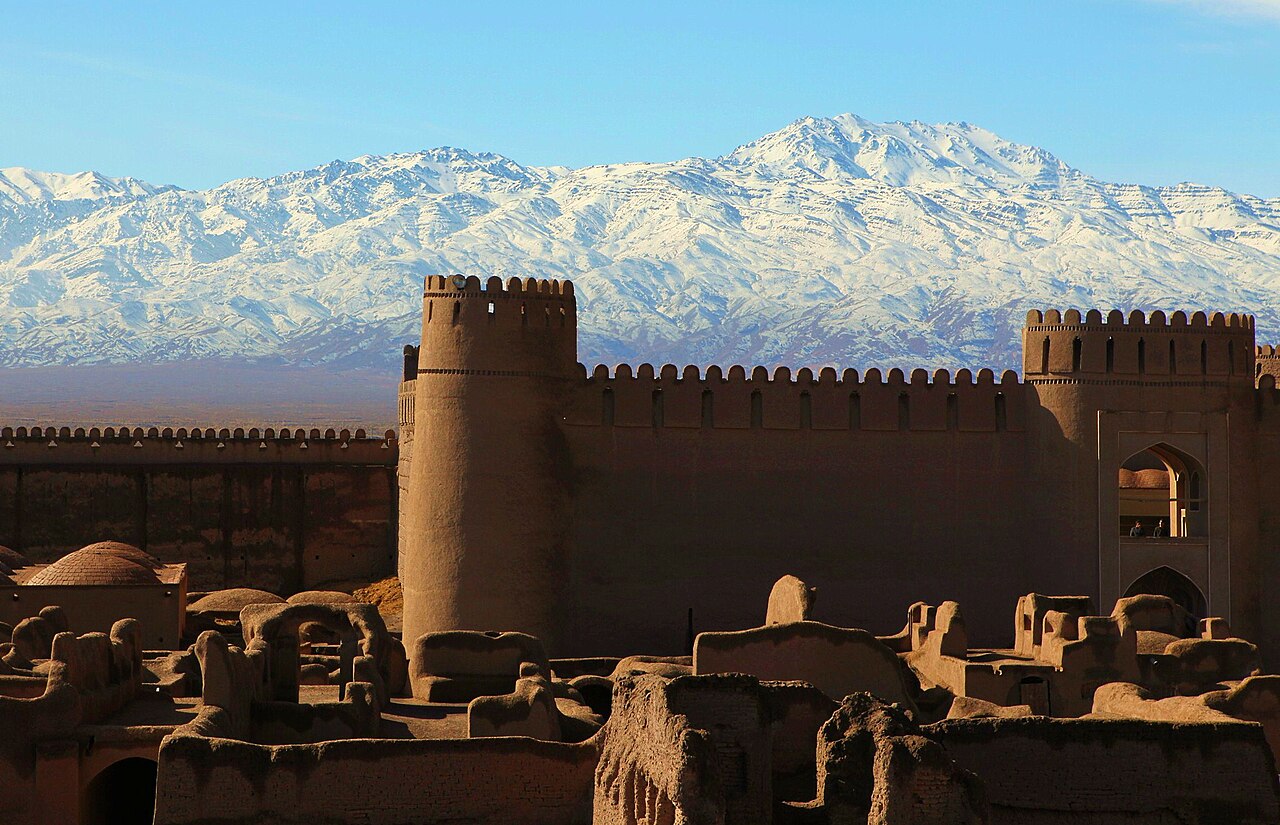
Rayen Castle (Arg-e Rayen) is a walled mud-brick town and citadel at Rayen, about 100 km south-east of Kerman. Smaller than Arg-e Bam but similar in plan, it is thought to have pre-Islamic roots and was lived in until the 19th century; because it survived the earthquakes that destroyed Bam in 2003, it is now the best place in Iran to see an old adobe citadel largely intact.
| Persian name | ارگ راین (Arg-e Râyen) |
|---|---|
| Location | Southern edge of the town of Rayen, Kerman province, below the Hezar mountains |
| Age | Probably Sasanian in origin; most of what stands is from the Islamic centuries |
| Size | About 22,000 square metres inside walls over 10 m high, with 16 towers |
| Inhabited until | About the 1860s |

A trading town on the edge of the mountains
Rayen sits where the mountains south of Kerman meet the plain, at about 2,200 metres, on old routes between Kerman, Bam and the south-east. Local tradition and Iranian sources place the first fortress here in the Sasanian period, and the town is mentioned in the history of Kerman in the first Islamic century. A popular story says the Arab armies could not take it because of its high walls; it is hard to prove, but it shows how proud the town was of its defences.
Written sources describe Rayen as a market for fine textiles and a centre for making swords and knives, and later guns. Knife-making is still the craft Rayen is known for, and small workshops in the modern town sell hand-made knives. The citadel is thought to have been inhabited until about 1868, when the people moved out to the newer town below. The older history of the region is outlined on our page on the Seljuks of Kerman and on Kerman.
What to look at
The walls and gate
The plan is roughly square, enclosed by a high wall with sixteen watchtowers. There is only one entrance, through a large gateway on the east side. Before going in, walk a little way along the outside of the walls: the battered mud-brick surfaces, rebuilt in places, give a good sense of how such defences were built and maintained.
The governor’s quarter
Inside, a lane leads past the main parts of the town to the governor’s quarter (حاکمنشین), raised above the rest. Its rooms around small courtyards, with wind openings and niches, have been restored, and from the upper levels you get the classic view: the honey-coloured walls and towers in the foreground and the often snow-capped Hezar mountains behind.
The town
The rest of the walled area was divided into quarters for the well-off and for ordinary people. Look for the bazaar lane, larger houses with courtyards, storehouses, a quarantine building, a schoolroom (maktab) and a building that guides describe as a fire temple. Some houses are still roofless ruins; others have been rebuilt. Because the town is smaller than Bam, it is easier to understand as a whole.
Rayen and Bam
Before 2003, Arg-e Bam was the famous one and Rayen a quiet side trip. After the earthquake, Rayen became the citadel that visitors could still walk through more or less as it had been. The two make a good pair: see the rebuilt walls and the ongoing work at Arg-e Bam, then Rayen to see how a mud-brick town looks after centuries of slow change rather than a single disaster.
Practical notes
- Rayen is about an hour and a half by road from Kerman and can be combined with Shazdeh Garden in Mahan on the same day, or visited on the way to Bam.
- At this altitude it is cooler than the desert towns; spring and autumn are the most comfortable times. Winter can be cold.
- Paths inside the citadel are uneven and some roofs and stairs are fragile; keep to marked routes. Check current opening hours and tickets locally.
Persian words from this page
| راین | Râyen | Rayen |
| ارگ | arg | citadel |
| برج دیدبانی | borj-e didbâni | watchtower |
| حاکمنشین | hâkem-neshin | governor’s quarter |
| چاقو | châghu | knife |
| مکتبخانه | maktab-khâne | traditional school |
Sources and further reading
- Persian Wikipedia, “ارگ راین” (plan, size and national registration), consulted November 2026.
- Encyclopaedia Iranica, “Kerman” (history and monuments of the province).
- Iran’s national heritage register, entry for Rayen castle (registered 1966).
- UNESCO World Heritage Centre, Bam and its Cultural Landscape, for comparison with the Bam citadel.
Want to learn Persian? Get the free Starter Pack
Get the 14-page printable Starter Pack (all 32 letters, a 7-day reading plan, 100 core words and 20 survival phrases) and a short 5-email course. Free.
More in Top Places to Visit in Iran
- Naqsh-e Jahan Square
- Shah (Imam) Mosque, Isfahan
- Sheikh Lotfollah Mosque
- Ali Qapu Palace
- Jameh Mosque of Isfahan
- Si-o-se Pol and Khaju Bridge
- Vank Cathedral
- Hasht Behesht Palace
- Naqsh-e Rostam
- Eram Garden, Shiraz
- Nasir al-Molk (Pink) Mosque
- Tomb of Hafez (Hafezieh)
- Tomb of Saadi (Saadieh)
- Shah Cheragh Shrine
- Arg of Karim Khan
- Fin Garden, Kashan
- Historic Houses of Kashan
- Jameh Mosque of Yazd
- Yazd Fire Temple and Towers of Silence
- Dowlatabad Garden and Windcatcher
- Amir Chakhmaq Complex
- Golestan Palace
- National Museum of Iran
- Treasury of National Jewels
- Tehran Grand Bazaar
- Milad Tower
- Imam Reza Shrine, Mashhad
- Tomb of Ferdowsi, Tus
- Tomb of Omar Khayyam, Neyshabur
- Tomb of Avicenna, Hamadan
- Ganjnameh Inscriptions, Hamadan
- Behistun (Bisotun): Visiting the Site
- Taq-e Bostan: Visiting the Site
- Tabriz Historic Bazaar
- Takht-e Soleyman
- Armenian Monastic Ensembles of Iran
- Sheikh Safi al-Din Shrine, Ardabil
- Dome of Soltaniyeh
- Alamut Castle
- Falak-ol-Aflak Castle
- Shushtar Historical Hydraulic System
- Chogha Zanbil: Visiting the Ziggurat
- Susa Archaeological Site
- Arg-e Bam
- Ganjali Khan Complex, Kerman
- Shazdeh Garden, Mahan
- Rayen Castle
- Dasht-e Lut (Lut Desert)
- Maranjab Desert and Caravanserai
- Varzaneh Desert
- Mount Damavand
- Hyrcanian Forests
- Lake Urmia
- Badab-e Surt Springs
- Ali Sadr Cave
- The Kaluts of Shahdad
- Qeshm Geopark
- Hormuz Island Colours
- Visiting Persepolis: A Day Trip from Shiraz
- Visiting Pasargadae
- Persian Caravanserais
- The Qanat of Gonabad
- Meymand Village
- Sasanian Sites of Fars: Firuzabad, Bishapur and Sarvestan
- Gonbad-e Qabus: Visiting the Tower
- Zayandeh Rud and Isfahan’s Bridges
- Tochal and Darband: Hiking Above Tehran
- Mount Sabalan
- Skiing in Iran: Dizin and Shemshak
- Golestan National Park